God: I Have Questions! (Part 1)

Straight Talk About God Part 1

In this series, I’m going to explore the topic of “God.” As a spiritual woman rooted in science and reason, I can’t help but question that thing that some call “God,” or rather, human beings’ creation of the “God” to whom they assign all kinds of images and meanings – based more on human behavior than on God Itself. This series will address these questions, not for the sake of providing proof of God or even an answer into the nature of God, but instead, to provide support for those like me whose lives have caused them to question what they were once told they must believe.

In the Catholic religion in which I was raised, God was a mystery and yet the Church, through doctrine and dogma, provided its own beliefs about God. As a post-Vatican II Catholic, my first lessons about the nature of God were all about love.  God was Love. God loved us without condition. God was all-loving and loved every single human being wholly and equally. This unconditional love, however, was also tempered with the caveat that God did love Catholics more than those of other faiths. Additionally, while being all-loving, God was punitive, jealous and wrathful. More than God’s love, we were taught to attend to God’s judgment. Breaking one of the ten commandments or sinning against the Church would earn you an eternity in hell, or if you were lucky, an extended stay in purgatory. If you were extra lucky, you had loved ones praying for your soul’s release from purgatory so that you could enjoy an eternity in heaven (that special heaven reserved only for Catholics) that much quicker.

As you can imagine, these conflicting images of God created a fair bit of cognitive dissonance in me, and I would guess, in most Catholics. Is God loving or is God punitive? Exploring scripture didn’t help the matter. The Old Testament God was wrathful, played favorites and destroyed those who were not His chosen ones. The New Testament God was equally confusing. Was God Love, as John’s letters suggested, unconditionally forgiving like the father in the story of the Prodigal Son, or did he separate sheep from goats and cast hulls into the fiery pits of hell? The Church only compounded this confusion by heaping conditions upon God’s love. Only IF we were a Catholic in “good standing,” and free from sin could we enjoy God’s heavenly reward. Further, freedom from sin was dependent upon full participation in the sacraments. Everything, it seemed, was conditional, including your own membership and participation in the Church. Sinners weren’t welcome. The divorced were shunned. Those “living in sin” were condemned. And single persons (who didn’t choose vowed religious life) were held in contempt.

At the end of the day, God was a cause for confusion and depending on who you asked, their answers about God differed. From priest to priest, nun to nun, parent to parent, friend to friend, everyone had their own beliefs about God. What life has shown me, is that not a single one of them were correct. Here is where my reason steps in. How can any single human being comprehend the great mystery that is our origin in creation? How can anyone fathom the Source from which we came, assuming there is even a source. The scientific truth is that our planet, everything upon this earth, including humankind, could simply be a random mistake of nature. At some time in the distant past, the perfect grouping of particles came together and poof – we were made. Did some Divine hand orchestrate this creation or is it simply the workings of chance? These are the questions that come to my mind when pondering about God.

You Did Nothing Wrong! It’s Not Your Fault!

I have grown increasingly weary of the new thought, new age, la la positivity movements and their “can-do” attitude subtly laced with shame and guilt. You know the routine:

  • “Think the right thoughts and you’ll get what you want.”
  • “If you don’t have what you want it’s because you aren’t thinking the right thoughts.”
  • “Don’t like your current life state?  Change your thoughts!”
  • “The state of your life is what you agreed to before you came here.”
  • “Suffering is an example of past life karma.”
  • “You must have done something wrong in a past life for this to happen….”
  • “You created this.”
  • “You create your reality.”
  • “If you want more you have to work hard.”

Yadda Yadda Yadda

On all of this I call BULL SHIT!

Seriously, the very last thing we need in our lives is a reinforcement of the messages many of us grew up with:  “You did something wrong. There’s something wrong with you.  It’s your fault. God is punishing you. God will punish you.”

Guilt. Shame. Blame. Over-responsibility.

Again, I call bullshit on this all.

Life is life. Period.

Sometimes in life we experience joy and ease. Sometimes life sucks and we die. Sometimes good things come from hard work. Sometimes only pain comes from hard work. Somedays we feel happy and joyful. Other days we feel depressed. Sometimes it seems we have the power to create our reality……..OR……..was the creation a function of privilege?

At 59 years old, I’ve learned there is really no rhyme or reason to life. Sometimes really bad people do nothing and seem to get everything they want. Often, really good people work really hard and get nothing. Perfectly healthy, really good young people get sick and die by no fault of their own, and absolutely terrible human beings get sick with a terminal illness and live for fucking ever!  No amount of thinking the right thoughts, praying the right prayers, or so-called life contracts or past life experiences change the circumstances of the human condition.

The human condition JUST IS. We have joy. We experience suffering. We find ease. We struggle. And none of this is our fault!!!!!  Our thoughts don’t dictate our life. Prayers and spells don’t change the course of fate. Life just is. And the last thing we need in the already difficult experience of being human is someone gloating about their good fortune and then telling us we don’t have what they do because we signed a life contract or thought the wrong thoughts. F*CK that SH*T!

But here is what we can do with life: Find resources and tools that help us to survive it!

  • Find a therapist.
  • Secure a spiritual director.
  • Ask your doctor for medicinal support (Zoloft is my friend).
  • Phone a friend.
  • Cultivate a daily practice that creates the space in which you can return to a place of inner peace.
  • Exercise.
  • Do what you love when you are able.
  • Drink coffee.  Eat chocolate. Love what you love in healthy amounts.
  • Find meaningful work if you are able, and if not, find something that doesn’t kill your soul.
  • Enjoy nature.
  • Create space to be fully present to your feelings: ALL OF THEM!
  • Honor your sorrow, depression, loneliness, and sense of abandonment. They all have something to teach you.
  • Find practices to free you from any and all guilt and shame based conditioning.
  • FREE YOURSELF from any and all person/teachers/tools that try to heap shame or guilt upon you.
  • And remember this:  YOU ARE A PRECIOUS AND GLORIOUS CHILD OF LOVE/God.  And if you have forgotten this, find tools to help you remember!
  • And if all else fails, exercise my favorite mantra:  F*CK This SH*T!

Revolution Poems

I write revolution poems

because what else is there to do

when the world around us is burning.

A runaway freight train

poised for destruction.

Devastation inevitable.

The collateral damage of

a species intent on its own extinction.

Staring in horror

as human rights are stripped away

and nations commit genocide.

Where truth is silenced

and old white men wave

their fascist flags

and clenched power fists.

From history the signs are known.

Repeating again

and again

and again.

“Do you hear the people sing?”

Indeed, they sing for thee.

I write revolution poems

because I don’t know what else to do.

copyright Lauri Ann Lumby

Sequestered and Waiting to Exhale

I’m writing today as a kind of “energy report” but I’m not sure these are even the proper words.  More accurately, I’m writing to share some deep observations of what seems to be happening for those of us who are here to be and share Love in the world.

This may not be universal, but I know for myself and those with whom I am in close contact, we have been sequestered. This is not surprising considering we are in the middle of an eclipse portal between the lunar eclipse on March 25th and the upcoming full solar eclipse on April 8th.  This is a big deal eclipse for the US as it makes a wide swath across the nation and will be visible across much of it.

This sequestering feels deep, quiet, and still. For myself, I haven’t had much to do but be. Actually, it’s been glorious. I’ve been living my favorite kind of life – private, silent, gentle, with lots of time for reading, creating, learning, praying, and just being. We even got socked in last night by a HUGE snowstorm that effectively closed most of Wisconsin. Hey, I will never be disappointed with a snowday where I get to stay home, do nothing, and be cozy.

But there’s much more to this sequestering than snowdays. While we are being sequestered, set apart, told to stay home and stay put, while we’re perhaps being deprived of anything related to doing or making things happen, the world out there is about to LOSE ITS SHIT!

The two biggies that draw my attention: The war in Gaza. The US Presidential election.

I’m not going into details because if you’ve been paying attention, you know.

It feels like the universe is holding its breath and we are holding ours with it as it all seems like a powder keg is about to go off.  And go off it will. These conflicts need to come to a head, and they will. Two metaphorical representations of that which has never served and which desperately needs to come to an end.

So we wait. We watch. We take note. We pay attention. BUT WE CANNOT be emotionally involved. We must stand back as objective witnesses to paradigms in their death throes, because WHEN THE SHIT HITS THE FAN, we have to be here, ready and able to step forward in whatever way we are called. 

Until then, we wait, sequestered, holding our breaths, and waiting for the moment we can exhale. It’s back to work for me tomorrow, but today I think I’ll be spending the majority of the day in prayer.

Painted Altars

I have painted my home in visual altars –

Uncountable reflections of that which I call God.

Jesus, Mary, and the Saints

Shining faces of Shekinah’s grace.

My children – living beacons of my joy.

The family from whence I came

and to the grave where one day I will go.

Everywhere I look I’m reminded of

Who I am,

Who I love,

Who I choose to be,

and

The death that will one day

welcome me home.


Starts April 10th

(click on the images to learn more)

Starts May 8th

Easter Means Nothing if We Don’t Know Love.

I’ve always struggled with the idea

that Jesus’ death and resurrection

opened the gates of heaven.

If we believe in the unconditionally loving God

about whom we were taught,

then to whom would those gates be closed?

As we sing our Alleluias

while closing our hearts to those

we don’t understand

or who believe differently,

then what good are our songs?

What are we celebrating

when we turn away from the poor,

reject the refugee,

and refuse care to those in need?

The purpose of the resurrection

is not so that “believers” might receive

their “get out of jail” card

while the rest suffer an eternity in hell.

Jesus’ rising simply proves that

Love is stronger than death.

The death that is made up of:

Prejudice and hatred.

Ignorance and greed.

Lust for power and pride.

And all the evils in between.

Love conquers it all.

But if we don’t know Love,

then Easter means nothing at all.

Copyright Lauri Ann Lumby


Starting April 10th

Wednesdays 6:30 – 8:30 pm central

A Magdalene Easter Reflection

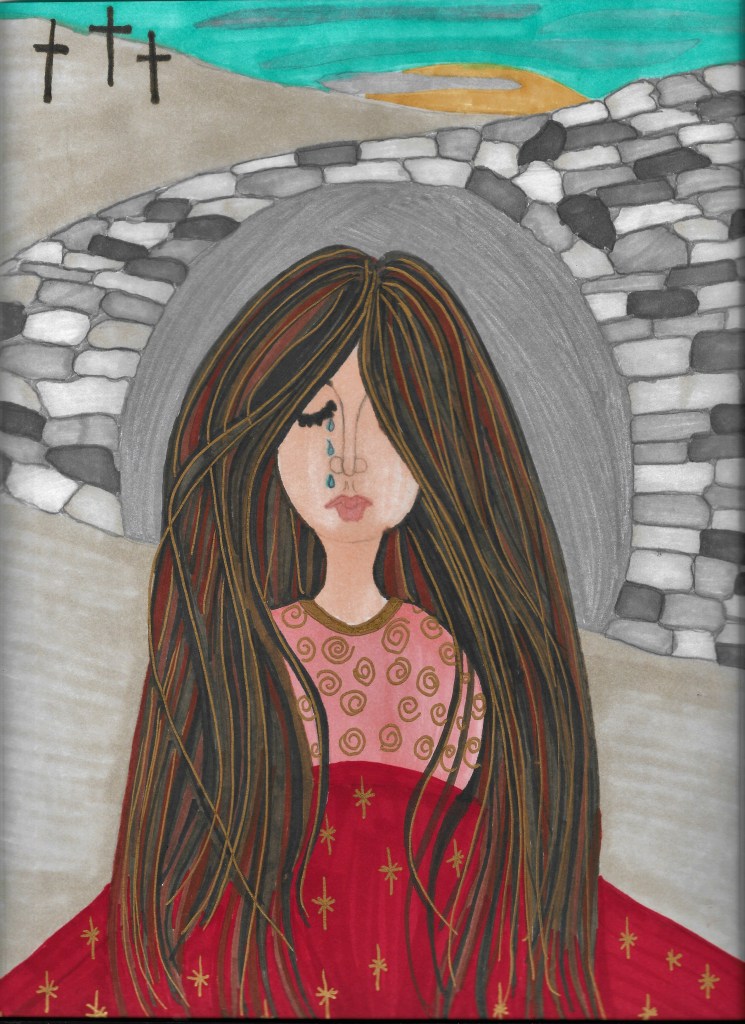
Early on the first day of the week, while it was still dark, Mary Magdalene went to the tomb and saw that the stone had been removed from the entrance.

Now Mary stood outside the tomb crying. As she wept, she bent over to look into the tomb and saw two angels in white, seated where Jesus’ body had been, one at the head and the other at the foot.

They asked her, “Woman, why are you crying?”

“They have taken my Lord away,” she said, “and I don’t know where they have put him.” At this, she turned around and saw Jesus standing there, but she did not realize that it was Jesus.

He asked her, “Woman, why are you crying? Who is it you are looking for?”

Thinking he was the gardener, she said, “Sir, if you have carried him away, tell me where you have put him, and I will get him.”

Jesus said to her, “Mary.”

She turned toward him and cried out in Aramaic, “Rabboni!” (which means “Teacher”).

Jesus said, “Do not hold on to me, for I have not yet ascended to the Father. Go instead to my brothers and tell them, ‘I am ascending to my Father and your Father, to my God and your God.’”

Mary Magdalene went to the disciples with the news: “I have seen the Lord!” And she told them that he had said these things to her.

John 20: 1, 11-18

(below is an excerpt from my online course Resurrecting the Magdalene)

Beyond our own personal reflections on the gospels, there are a few things we may be able to surmise from the texts, especially for our current purpose of understanding what might really have taken place during the events surrounding Jesus’ resurrection.

  • In each and every gospel account, Mary Magdalene is named as one who is witness to the resurrection.  The same cannot be said of any other “named” witness.
  • Scripture scholars further highlight this point in noting that Mary is named.  Scholarly consensus holds that for a woman to have been named, she must have had a central and critical role in the story of Jesus (remember, women had no personal value within the culture of first-century Palestine).  Mary is named in every gospel account of the resurrection, including that portrayed in the Gospel of Mary Magdalene (one of those that didn’t make the cut).   
  • Beyond being named in scripture as witness to the resurrection, Tradition has always honored Mary Magdalene as first witness to the resurrection, so much so that in the very early Church, Mary was identified as “Apostle to the Apostles,” for this is what she was.

“But what about Peter?” we might ask.  He is named in both the gospel of Luke and the gospel of John.  There is an easy explanation for Peter being named in Luke’s gospel.  Scripture scholars tell us it is unlikely that the author of Luke was a direct follower of Jesus.  Instead, Luke was most likely a follower of St. Paul, who actually never met Jesus personally.  Paul (as Saul of Tarsus) was initially a persecutor of the followers of Jesus, himself ordering the stoning of St. Stephen, the first martyr.  Paul later had some sort of mystical experience through which he encountered the risen Christ and then became a champion for the Jesus cause.  Paul likely gained his knowledge of the Jesus story from Peter and the other male disciples who presided over the first Christian community in Jerusalem, long after Mary Magdalene left the scene (more on that in the next lesson).  By this time, it is likely that the Petrine (Peter) agenda had already been cemented within the Jerusalem community.  Because Mary played such an integral part in the resurrection experience, she could not be omitted altogether, but her role was easily downplayed by having Peter, himself, witness to the empty tomb.   

Then there is the gospel of John.  John’s gospel is markedly different from any of the other gospels and seems to be of a genre unto itself – a gospel that is a theological reflection on the first 100 years of the Jesus movement and on some of the traditions, rituals, and practices that had already become part of the emerging Christian tradition.  While one of the later gospels written, John’s gospel also possesses parts of the Mary Magdalene tradition that are not present (or are downplayed) in the other gospels including the Wedding at Cana, the story of the Samaritan Woman at the Well and the Anointing at Bethany.  In regards to the story of the resurrection, John’s gospel presents a study in contrasts.  First, Mary goes to the tomb.  She then runs to tell Peter, who comes to the tomb to see that it is empty.  After Peter (and the unnamed disciple) departs Mary sticks around and has a direct and personal encounter with Jesus, who then tells her to go tell the other disciples. 

The conflicting information in this gospel has confounded me for years, until I brought this reading into deep prayer and meditation.  Through this approach, the answer became glaringly obvious.  The gospel of John contains two separate stories of the resurrection account – one in which Mary is the witness, another where Peter is given privilege.  It is my personal belief that the passage regarding Peter was inserted into the Mary story to suit the later Christian Church (second – third century) who sought to put forth a decidedly patriarchal and hierarchical agenda and who had already designated Peter (in tradition if not in fact) leader of the early Church and the first Pope (Historically, Peter never acted in any role similar to that of Pope.  There is also doubt as to whether or not he actually made it as far as Rome).  Within this agenda, there can be no room for a woman who was obviously commissioned to a leadership role by none other than Jesus, himself.  But, don’t take my word for it.  Go back and re-read the resurrection account from John and then decide for yourself. 

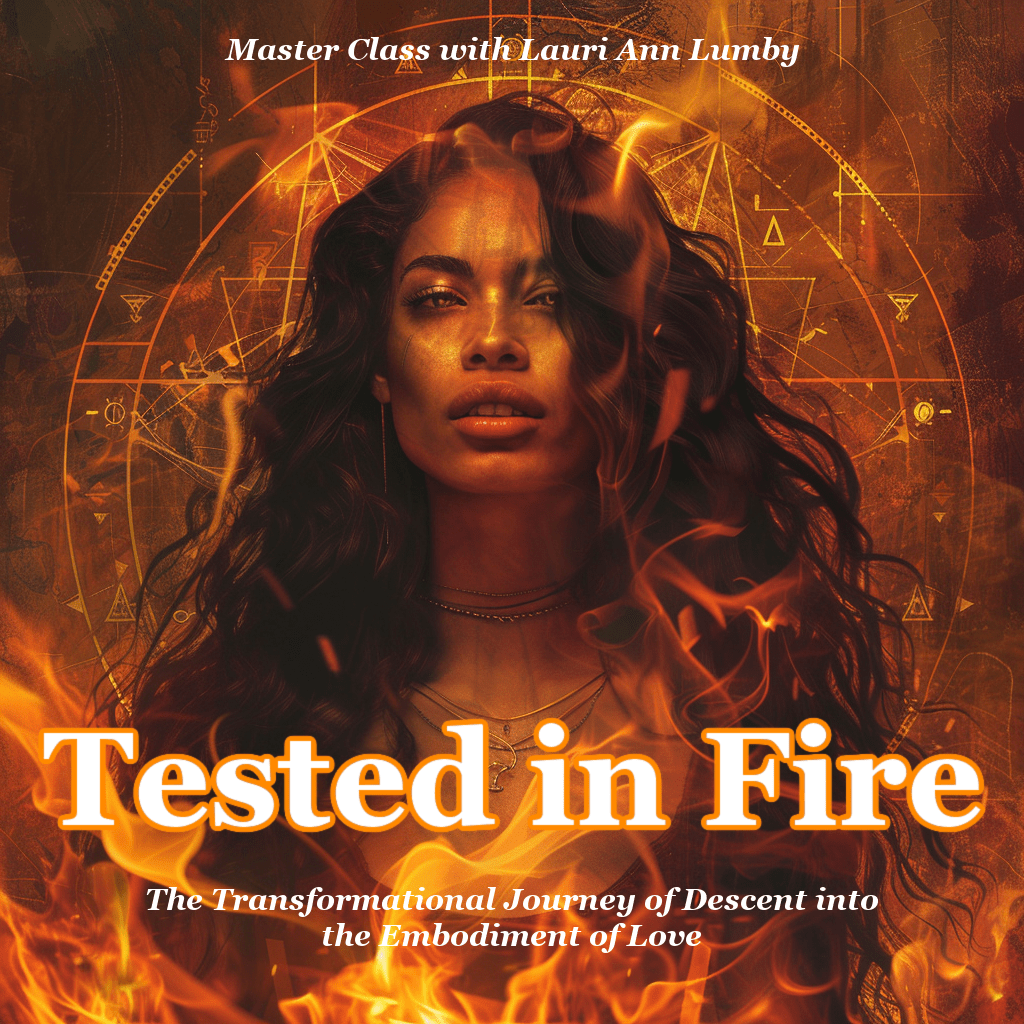
Tested in Fire: New LIVE Course

Live online course with Lauri Ann Lumby

Six sessions

Wednesdays 6:30 – 8:30 pm central time

May 8 – June 12, 2024

Live via ZOOM*

After we have tasted the unifying experience of Union with God/Source/Love that we experience at ascension (enlightenment, bliss, etc.) we are cast out of that bliss into a process in which we are “tested like gold that is tested in fire.” The ancients have called this the journey of descent.  Here we come face to face with all the aspects of ourselves that are not wholly rooted in love: our unhealed fears, past traumas, societal conditioning, and ego attachments. In this we are invited to confront our own inner “demons” and transform them into vehicles of Love so that we might fulfill the purpose of the human spiritual journey – the embodiment of Love/God.

In this six-week course, you will:

  • Explore the psychology of the journey of descent as it relates to human development.
  • Acknowledge and confront the challenges inherent in the journey of descent.
  • Learn the language and stages of descent through the Tree of Life as articulated in ancient pre-Christian mystical traditions.
  • Come to understand the Tree of Death as a vehicle of liberation from egoic attachments.
  • Find support in identifying that which limits your ability to know and be Love.
  • Provided with tools for transforming the “demons” experienced in the journey of descent into vehicles of Love.
  • Grow in becoming the embodiment of Love.

This course is:

  • Inspired by scholarship
  • Anchored in original source material
  • Grounded in sound mindfulness and creativity practices
  • Incorporating tried and tested methods for transformation
  • Rooted in the psychology of human development

** For those who have already taken the Beyond Ascension course, Tested in Fire stands on its own while going into much greater depth than was able to be covered in the Beyond Ascension class.  

Good Words

This is just such a good reading I wanted to share it with a little practice at the end if you feel so-called.

The Lord GOD has given me
            a well-trained tongue,
That I might know how to speak to the weary
            a word that will rouse them.
Morning after morning
            he opens my ear that I may hear;
And I have not rebelled,
            have not turned back.
I gave my back to those who beat me,
            my cheeks to those who plucked my beard;
My face I did not shield
            from buffets and spitting.

The Lord GOD is my help,
            therefore I am not disgraced;
I have set my face like flint,
            knowing that I shall not be put to shame.
He is near who upholds my right;
            if anyone wishes to oppose me,
            let us appear together.
Who disputes my right?
            Let him confront me.
See, the Lord GOD is my help;
            who will prove me wrong?

Isaiah 50: 4-9a

Meditation Practice:

If you feel so-called, apply Lectio-Divina to the scripture passage above and share your experience in the comment section.

Lectio Divina

Lectio Divina is Latin for “divine reading,” “spiritual reading,” or “holy reading” and represents a method of prayer and scriptural reading intended to promote communion with God and to provide special spiritual insights.  Traditionally, Lectio-Divina is practiced with sacred scripture, but can be applied to any inspirational or meaningful written text.  Lectio Divina is accomplished in four steps, with the fourth step – contemplation – continuing beyond our practice time and flowing out into our day.

Lectio – Choose a scripture passage or inspirational written text.  Read the passage gently and slowly several times, savoring each portion of the reading.  As you are reading, look for a word or phrase that seems to jump out at you.  Receive this word or phrase as God’s nourishment for you.

Meditatio – Reflect on the text of the passage and think about how it applies to one’s own life. Specifically, ruminate, ponder, meditate on the word or phrase that jumped out at you.  Ask the question, “How is God speaking to me personally through this passage?”

Oratio – Respond to the passage by opening your heart to God. Allow yourself to have a conversation with God.  Offer a silent or spoken prayer in response to God, or write your thoughts in a notebook or journal.

Contemplatio – Listening to God. This is a freeing of yourself from your own thoughts, both mundane and holy, and hearing God speak to you. Opening the mind, heart, and soul to the influence of God. Contemplatio is often done in silence or carried with you as you go about your day.  Observe how your meditation period continues to influence your thoughts, behaviors, attitudes and feelings.


LIVE COURSE

Starting April 10th.

The Four Pillars

The Order of the Magdalene with Lauri Ann Lumby is firmly rooted in the four pillars of:

  • Spirituality
  • Science
  • Psychology
  • Education

The Order of the Magdalene is founded on the belief that pillars are not meant to contain or control but are intended to uplift while providing ongoing encouragement and support. It is a model based on empowerment, not on oppression.

Psychology – specifically Human Development

The primary focus of the Order of the Magdalene is to provide education, resources, and tools which support human beings in becoming self-actualized. Self-actualization, a term first coined by Kurt Goldstein and then popularized by Abraham Maslow, is a process by which human beings are compelled toward reaching their full potential.  Maslow defined self-actualization as:

            Self-actualization (also referred to as self-realization or self-cultivation) can be described as the complete realization of one’s potential as manifest in peak experiences which involve the full development of one’s abilities and appreciation for life. (Maslow, 1962)

Self-actualized people know:

  • Who they are.
  • How they are uniquely gifted.
  • How they are called to live out those gifts for the sake of their own fulfillment and in service to the betterment of the world.

Furthermore, self-actualized people have found a deep sense of inner contentment, along with a sense of meaning and purpose in their lives. Becoming self-actualized is the ultimate fulfillment of the human journey.

Spirituality

Spirituality is inherent in every person. Each one of us is driven by an invisible force that compels us to seek meaning and purpose in our lives. Connecting with this invisible force (however we define or identify that force) helps us to access inner guidance, knowledge, understanding, contentment, and peace. The Order of the Magdalene supports the unique spiritual journey and spiritual development of each individual by providing tools and practices that are universal and free of doctrine or dogma.  Here western and eastern contemplative practices meet, providing a path consistent with our increasingly wholistic and secular world.  Instead of experiencing these practices through the lens of division, we find union in an open dialog and exploration of all the ways in which human beings have nurtured this inherent yearning to explore mystery. In this way, we are empowered to discover our own truth along with the path of our highest good.

Science

History has shown us the endurance of spiritual/contemplative practices including mindfulness, meditation, silence, and contemplation, and the benefits experienced by those dedicated to these practices. With recent advances in science, specifically neurobiology, we can now see the proof of what before were only theories based on subjective observation.  Through the science of such pioneers as Zinn, Davidson, and Newberg, the Order of the Magdalene has found validation and support for our methods.

Education

With training in adult education, developmental psychology, spiritual formation, and project-based learning, Lauri Ann Lumby, founder, and spiritual director of the Order of the Magdalene, has created an experiential learning model that is adaptable to the individual learning style and temperament of each participant. One-on-one support provides the additional resources that guarantee that the individual needs of each client and student are met and their formative desires fulfilled.

Putting it All Together

Through a solid foundation built upon the four pillars of psychology, spirituality, science and education, The Order of the Magdalene provides a comprehensive approach to the process of human development.  Self-actualization is supported through our online classes, workshops, books, community gatherings and one-on-one support. 


Surviving the Long Dark Night

LIVE (via ZOOM) online course

Wednesdays 6:30 – 8:30 pm central time

April 10, 17, 24, 2024

Created and facilitated by Lauri Ann Lumby