Early on the first day of the week, while it was still dark, Mary Magdalene went to the tomb and saw that the stone had been removed from the entrance.
Now Mary stood outside the tomb crying. As she wept, she bent over to look into the tomb and saw two angels in white, seated where Jesus’ body had been, one at the head and the other at the foot.
They asked her, “Woman, why are you crying?”
“They have taken my Lord away,” she said, “and I don’t know where they have put him.” At this, she turned around and saw Jesus standing there, but she did not realize that it was Jesus.
He asked her, “Woman, why are you crying? Who is it you are looking for?”
Thinking he was the gardener, she said, “Sir, if you have carried him away, tell me where you have put him, and I will get him.”
Jesus said to her, “Mary.”
She turned toward him and cried out in Aramaic, “Rabboni!” (which means “Teacher”).
Jesus said, “Do not hold on to me, for I have not yet ascended to the Father. Go instead to my brothers and tell them, ‘I am ascending to my Father and your Father, to my God and your God.’”
Mary Magdalene went to the disciples with the news: “I have seen the Lord!” And she told them that he had said these things to her.
John 20: 1, 11-18
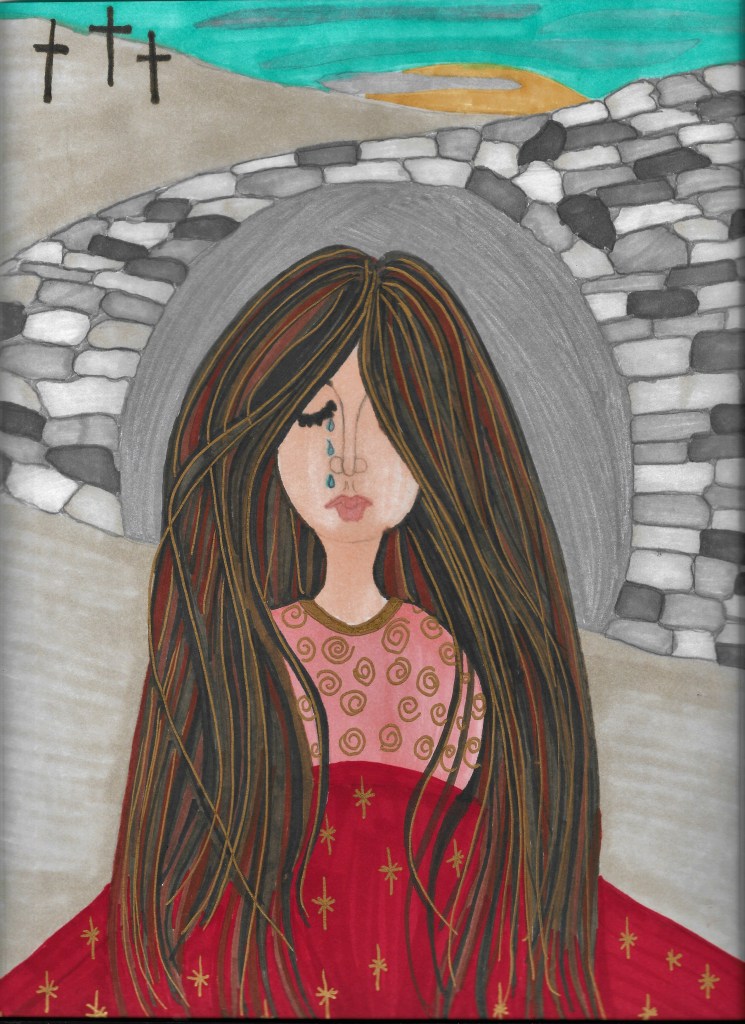
(below is an excerpt from my online course Resurrecting the Magdalene)
Beyond our own personal reflections on the gospels, there are a few things we may be able to surmise from the texts, especially for our current purpose of understanding what might really have taken place during the events surrounding Jesus’ resurrection.
- In each and every gospel account, Mary Magdalene is named as one who is witness to the resurrection. The same cannot be said of any other “named” witness.
- Scripture scholars further highlight this point in noting that Mary is named. Scholarly consensus holds that for a woman to have been named, she must have had a central and critical role in the story of Jesus (remember, women had no personal value within the culture of first-century Palestine). Mary is named in every gospel account of the resurrection, including that portrayed in the Gospel of Mary Magdalene (one of those that didn’t make the cut).
- Beyond being named in scripture as witness to the resurrection, Tradition has always honored Mary Magdalene as first witness to the resurrection, so much so that in the very early Church, Mary was identified as “Apostle to the Apostles,” for this is what she was.
“But what about Peter?” we might ask. He is named in both the gospel of Luke and the gospel of John. There is an easy explanation for Peter being named in Luke’s gospel. Scripture scholars tell us it is unlikely that the author of Luke was a direct follower of Jesus. Instead, Luke was most likely a follower of St. Paul, who actually never met Jesus personally. Paul (as Saul of Tarsus) was initially a persecutor of the followers of Jesus, himself ordering the stoning of St. Stephen, the first martyr. Paul later had some sort of mystical experience through which he encountered the risen Christ and then became a champion for the Jesus cause. Paul likely gained his knowledge of the Jesus story from Peter and the other male disciples who presided over the first Christian community in Jerusalem, long after Mary Magdalene left the scene (more on that in the next lesson). By this time, it is likely that the Petrine (Peter) agenda had already been cemented within the Jerusalem community. Because Mary played such an integral part in the resurrection experience, she could not be omitted altogether, but her role was easily downplayed by having Peter, himself, witness to the empty tomb.
Then there is the gospel of John. John’s gospel is markedly different from any of the other gospels and seems to be of a genre unto itself – a gospel that is a theological reflection on the first 100 years of the Jesus movement and on some of the traditions, rituals, and practices that had already become part of the emerging Christian tradition. While one of the later gospels written, John’s gospel also possesses parts of the Mary Magdalene tradition that are not present (or are downplayed) in the other gospels including the Wedding at Cana, the story of the Samaritan Woman at the Well and the Anointing at Bethany. In regards to the story of the resurrection, John’s gospel presents a study in contrasts. First, Mary goes to the tomb. She then runs to tell Peter, who comes to the tomb to see that it is empty. After Peter (and the unnamed disciple) departs Mary sticks around and has a direct and personal encounter with Jesus, who then tells her to go tell the other disciples.
The conflicting information in this gospel has confounded me for years, until I brought this reading into deep prayer and meditation. Through this approach, the answer became glaringly obvious. The gospel of John contains two separate stories of the resurrection account – one in which Mary is the witness, another where Peter is given privilege. It is my personal belief that the passage regarding Peter was inserted into the Mary story to suit the later Christian Church (second – third century) who sought to put forth a decidedly patriarchal and hierarchical agenda and who had already designated Peter (in tradition if not in fact) leader of the early Church and the first Pope (Historically, Peter never acted in any role similar to that of Pope. There is also doubt as to whether or not he actually made it as far as Rome). Within this agenda, there can be no room for a woman who was obviously commissioned to a leadership role by none other than Jesus, himself. But, don’t take my word for it. Go back and re-read the resurrection account from John and then decide for yourself.
 Lauri Ann Lumby