(Mary reported to the disciples what the Teacher had revealed to her) “’I left the world with the aid of another world; a design was erased, by virtue of a higher design. Henceforth I travel toward Repose, where time rests in the Eternity of Time; I go now into Silence.’”
Having said all this, Mary became silent, for it was in silence that the Teacher spoke to her.
Then Andrew began to speak, and said to his brothers: “Tell me, what do you think of these things she has been telling us? As for me, I do not believe that the Teacher would speak like this.These ideas are too different from those we have known.”
And Peter added:“How is it possible that the Teacher talked in this manner with a woman about secrets of which we ourselves are ignorant? Must we change our customs, and listen to this woman? Did her really choose her, and prefer her to us?”
Then Mary wept, and answered him:
“My brother Peter, what can you be thinking? Do you believe that this is just my imagination, that I invented this vision? Or do you believe that I would lie about our Teacher?”
At this, Levi spoke up:“Peter, you have always been hot=tempered, and now we see you repudiating a woman, just as our adversaries do.Yet if the Teacher held her worthy, who are you to reject her? Surely the Teacher knew her very well, for he loved her move than us. Therefore, let us atone, and become fully human (Anthropos) so that the Teacher can take root in us.Let us grow as he demanded of us, and walk forth to spread the gospel, without trying to lay down any rules and laws other than those he witnessed.”
The Gospel of Mary Magdalene pp 17-18. Translation by John Yves-Leloup
In a world filled with false prophets, impostors, self-appointed gurus, charlatans, snake-oil salespeople, and millionaire pastors, it is imperative that we become ever-more vigilant with our own impeccability. Millions of people are starving for guidance and direction, answers to life’s unanswerable questions, and comfort from the terrors of this world. There are equally many who are happy to provide people with what they want. Many of these are of integrity, educated and trained in what they provide, responsible and careful in that provision, and accountable to the established ethics of their field. Some are not.
Impeccability is about more than just our word. It is about what we say, how we say it, what we mean by it, the authority behind it, our education and training, to whom we are accountable, and on what we base our word. Let me provide an example from the world of the Magdalene.
Since the early 90’s, literally hundreds of so-called authorities on The Magdalene have made themselves known. Some are academic scholars providing the findings of research that has been examined under the rigors of peer-review. Some are historians who have embarked on a treasure hunt seeking out clues to the Magdalene legends as they were handed down through folklore, art, cultural traditions, and monuments created in her name. Some are the holders of oral traditions that have been handed down for thousands of years. Some receive their knowledge through dreams, visions, intuitive guidance, and their creative imaginations. Others are just making shit up.
The Magdalene field has become as vast as it is deep. There is something in this field for everyone. Something for those simply seeking entertainment. Something for the scholars and academics. Something for the new age community. Something for the witches and goddess worshippers. Something for those looking for an outside perceived authority to tell them what is true and what to believe. Something for those who simply want someone to blow smoke up their ass, telling them what they want to hear. There is now a Magdalene for everyone. This does NOT mean that every Magdalene is authentic or true. As I posted on Facebook the other day:
Someone, apparently didn’t like what I posted, thinking I was throwing shade. Well….maybe I was throwing a little shade….but here’s my come-from as it relates to the Magdalene and by association, impeccability:
You do you – but be clear about your come from.
In my Magdalene work, for example, I do my best to be clear. “This is based on scholarship….this is a work of fiction…this came through my intuition/creative imagination…I completely made this up but I would love for it to be true.” I’m also careful to identify my resources, remaining as close to authentic scholarship where possible and explaining where these resources reside in the spectrum of verifiable fact, theory, or simply oral tradition or legend. I’m admittedly a stickler for scholarship that is soundly rooted in the scientific method.
When we are clear about our come-from, then people know how to take the resources, guidance, and support we provide for them and apply them (or not) in their lives. This is true whether it be about the Magdalene, spiritual direction, counseling, healing, or just giving advice as it relates to our mutual fields of expertise. I believe this is especially important, critical even, when we present ourselves as teachers, guides, or healers for others.
We must be impeccable about what we are offering and how it is to be used and received. If we aren’t doing this, people could actually be harmed. As I said before, there are millions of vulnerable people looking for comfort and guidance and our job is not to enable them or take advantage of their vulnerability. Our job is to empower them. We can’t do this if we aren’t impeccable with our words, our motivations, our source of knowledge, and our actions.
In other words: Be honest. Be clear. And Check Yourself!
Early on the first day of the week, while it was still dark, Mary Magdalene went to the tomb and saw that the stone had been removed from the entrance.
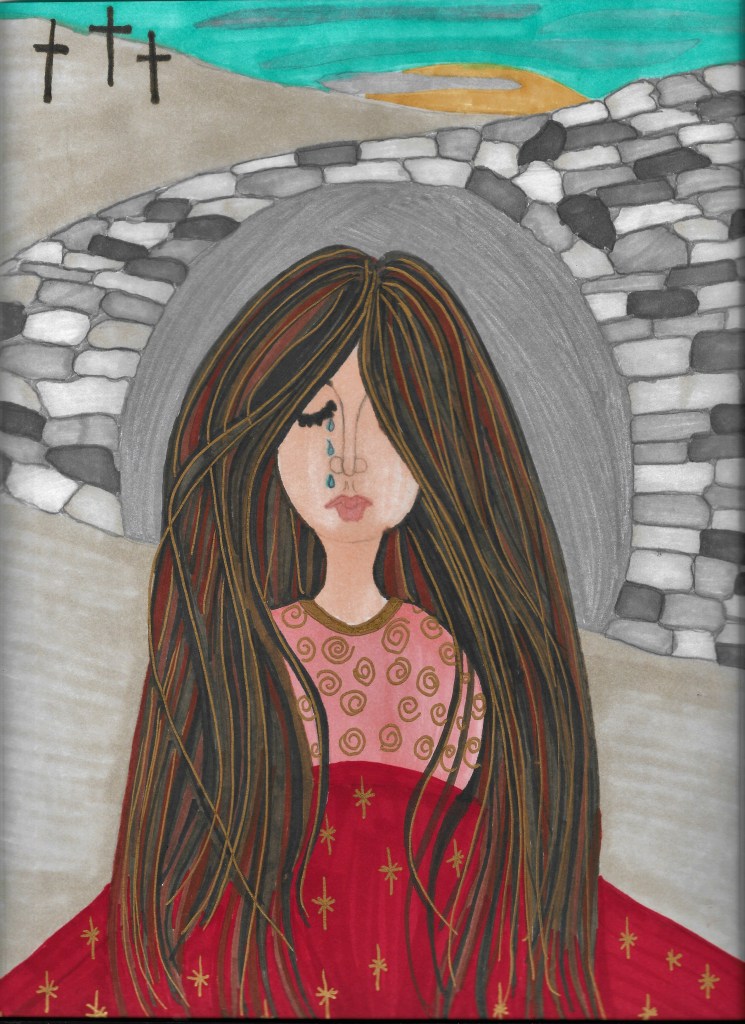
Now Mary stood outside the tomb crying. As she wept, she bent over to look into the tomb and saw two angels in white, seated where Jesus’ body had been, one at the head and the other at the foot.
They asked her, “Woman, why are you crying?”
“They have taken my Lord away,” she said, “and I don’t know where they have put him.” At this, she turned around and saw Jesus standing there, but she did not realize that it was Jesus.
He asked her, “Woman, why are you crying? Who is it you are looking for?”
Thinking he was the gardener, she said, “Sir, if you have carried him away, tell me where you have put him, and I will get him.”
Jesus said to her, “Mary.”
She turned toward him and cried out in Aramaic, “Rabboni!” (which means “Teacher”).
Jesus said, “Do not hold on to me, for I have not yet ascended to the Father. Go instead to my brothers and tell them, ‘I am ascending to my Father and your Father, to my God and your God.’”
Mary Magdalene went to the disciples with the news: “I have seen the Lord!” And she told them that he had said these things to her.
Beyond our own personal reflections on the gospels, there are a few things we may be able to surmise from the texts, especially for our current purpose of understanding what might really have taken place during the events surrounding Jesus’ resurrection.
In each and every gospel account, Mary Magdalene is named as one who is witness to the resurrection. The same cannot be said of any other “named” witness.
Scripture scholars further highlight this point in noting that Mary is named. Scholarly consensus holds that for a woman to have been named, she must have had a central and critical role in the story of Jesus (remember, women had no personal value within the culture of first-century Palestine). Mary is named in every gospel account of the resurrection, including that portrayed in the Gospel of Mary Magdalene (one of those that didn’t make the cut).
Beyond being named in scripture as witness to the resurrection, Tradition has always honored Mary Magdalene as first witness to the resurrection, so much so that in the very early Church, Mary was identified as “Apostle to the Apostles,” for this is what she was.
“But what about Peter?” we might ask. He is named in both the gospel of Luke and the gospel of John. There is an easy explanation for Peter being named in Luke’s gospel. Scripture scholars tell us it is unlikely that the author of Luke was a direct follower of Jesus. Instead, Luke was most likely a follower of St. Paul, who actually never met Jesus personally. Paul (as Saul of Tarsus) was initially a persecutor of the followers of Jesus, himself ordering the stoning of St. Stephen, the first martyr. Paul later had some sort of mystical experience through which he encountered the risen Christ and then became a champion for the Jesus cause. Paul likely gained his knowledge of the Jesus story from Peter and the other male disciples who presided over the first Christian community in Jerusalem, long after Mary Magdalene left the scene (more on that in the next lesson). By this time, it is likely that the Petrine (Peter) agenda had already been cemented within the Jerusalem community. Because Mary played such an integral part in the resurrection experience, she could not be omitted altogether, but her role was easily downplayed by having Peter, himself, witness to the empty tomb.
Then there is the gospel of John. John’s gospel is markedly different from any of the other gospels and seems to be of a genre unto itself – a gospel that is a theological reflection on the first 100 years of the Jesus movement and on some of the traditions, rituals, and practices that had already become part of the emerging Christian tradition. While one of the later gospels written, John’s gospel also possesses parts of the Mary Magdalene tradition that are not present (or are downplayed) in the other gospels including the Wedding at Cana, the story of the Samaritan Woman at the Well and the Anointing at Bethany. In regards to the story of the resurrection, John’s gospel presents a study in contrasts. First, Mary goes to the tomb. She then runs to tell Peter, who comes to the tomb to see that it is empty. After Peter (and the unnamed disciple) departs Mary sticks around and has a direct and personal encounter with Jesus, who then tells her to go tell the other disciples.
The conflicting information in this gospel has confounded me for years, until I brought this reading into deep prayer and meditation. Through this approach, the answer became glaringly obvious. The gospel of John contains two separate stories of the resurrection account – one in which Mary is the witness, another where Peter is given privilege. It is my personal belief that the passage regarding Peter was inserted into the Mary story to suit the later Christian Church (second – third century) who sought to put forth a decidedly patriarchal and hierarchical agenda and who had already designated Peter (in tradition if not in fact) leader of the early Church and the first Pope (Historically, Peter never acted in any role similar to that of Pope. There is also doubt as to whether or not he actually made it as far as Rome). Within this agenda, there can be no room for a woman who was obviously commissioned to a leadership role by none other than Jesus, himself. But, don’t take my word for it. Go back and re-read the resurrection account from John and then decide for yourself.
In honor of today’s Easter celebration, I’m sharing an excerpt from the Gospel of Mary (Magdalene). In Mary’s gospel we see the full extent of how she counselled and taught the other disciples. She was their teacher after Jesus’ death.
“Impose no law
other than that which I have witnessed.
Do not add more laws to those given in the Torah,
lest you become bound by them.”
Having said all this, he (Jesus) departed.
The disciples were in sorrow,
shedding many tears, and saying:
“How are we to go among the unbelievers
and announce the gospel of the Kingdom of the Son of Man?
They did not spare his life,
so why should they spare ours?”
Then Mary arose,
embraced them all, and began to speak to her brothers:
“Do not remain in sorrow and doubt,
for his Grace will guide you and comfort you.
Instead, let us praise his greatness,
for he has prepared us for this.
He is calling upon us to become fully human (Anthropos).”
Thus Mary turned their hearts toward the Good,
and they began to discuss the meaning of the Teacher’s words.
In this lesson, we explore the four gospel accounts of the Resurrection of Jesus. When read side-by-side, what immediately becomes obvious is how much these four accounts differ from one another. Did an angel appear first, or Jesus? Did Jesus appear at all or did the disciples only witness an “angel” and an empty tomb? If Jesus did show himself, to whom did he appear – Mary Magdalene alone, Mary in the company of other women, Peter and/or the unnamed disciple?
First Witness
Modern-day scripture scholars have helped us to understand the marked differences between the four gospels, not just in the disparity between the resurrection accounts, but in all that differs from one gospel to the next. A few bullet points to help us understand this disparity:
In the first three centuries after Jesus’ death, hundreds of communities developed around his teachings, each led by one of the original disciples (with the exception of St. Paul) or others who closely followed Jesus, and their subsequent followers.
Each of these communities had their own version of the Jesus story and his teachings.
These stories were not written down until 30-70 years after Jesus’ death. These writing were derived from oral tradition first (think of the telephone game) and it is unlikely that they are first-hand accounts.
These stories were written by a specific author, speaking to a specific audience, desiring to make a specific point. For example, the gospel of Matthew was written to a Jewish audience and attempts to prove, through the use of Hebrew scripture references, that Jesus was the foretold and promised Messiah.
The literary genre of the gospels is unique unto its self, yet is consistent with the Jewish practice of Midrash – an interpretive and reflective narrative meant to plumb the deeper spiritual meaning within a religious text or teaching. In other words, the gospels were never meant to be taken as literal truth.
Only four of these hundreds of communities’ versions of the Jesus story made the “cut” and were included in what we now know as The Bible. This decision was first asserted by Irenaeus in the second century because these specific books supported the political agenda of the emerging Church. This decision was verified in the fourth century after Christianity was named the official religion of the Roman Empire, because these writings supported the political agenda of the Roman Emperor, Constantine.
Many of the stories contained within the books that “made the cut” were redacted (altered) to fit the specific agenda of the emerging Church, first, and later, the Roman Empire (more on this when we discuss the gospel of John).
The bottom line is that we have no way of knowing the literal truth of any of the gospels, only that they communicate stories that were handed down for many years before they were written down by specific people for a specific audience, based on what they remembered or, more likely, what they wanted their audience to believe about Jesus, his life, and his teachings. That is not to say, however, that the gospels do not contain deep and profound truths – especially when we extract the gospel stories from the doctrine that has been developed around then, bringing them into our own prayer, and allowing God to reveal the truths contained within the stories that are personally relevant to us in our own journeys.
Teacher
Beyond our own personal reflections on the gospels, there are a few things we may be able to surmise from the texts, especially for our current purpose of understanding what might really have taken place during the events surrounding Jesus’ resurrection.
In each and every gospel account, Mary Magdalene is named as one who is witness to the resurrection. The same cannot be said of any other “named” witness.
Scripture scholars further highlight this point in noting that Mary is named. Scholarly consensus holds that for a woman to have been named, she must have had a central and critical role in the story of Jesus (remember, women had no personal value within the culture of first-century Palestine). Mary is named in every gospel account of the resurrection, including that portrayed in the Gospel of Mary Magdalene (one of those that didn’t make the cut).
Beyond being named in scripture as witness to the resurrection, Tradition has always honored Mary Magdalene as first witness to the resurrection, so much so that in the very early Church, Mary was identified as “Apostle to the Apostles,” for this is what she was.
“But what about Peter?” we might ask. He is named in both the gospel of Luke and the gospel of John. There is an easy explanation for Peter being named in Luke’s gospel. Scripture scholars tell us it is unlikely that the author of Luke was a direct follower of Jesus. Instead, Luke was most likely a follower of St. Paul, who actually never met Jesus personally. Paul (as Saul of Tarsus) was initially a persecutor of the followers of Jesus, himself ordering the stoning of St. Stephen, the first martyr. Paul later had some sort of mystical experience through which he encountered the risen Christ and then became a champion for the Jesus cause. Paul likely gained his knowledge of the Jesus story from Peter and the other male disciples who presided over the first Christian community in Jerusalem, long after Mary Magdalene left the scene (more on that in the next lesson). By this time, it is likely that the Petrine (Peter) agenda had already been cemented within the Jerusalem community. Because Mary played such an integral part in the resurrection experience, she could not be omitted altogether, but her role was easily downplayed by having Peter, himself, witness to the empty tomb.
Then there is the gospel of John. John’s gospel is markedly different from any of the other gospels and seems to be of a genre unto itself – a gospel that is a theological reflection on the first 100 years of the Jesus movement and on some of the traditions, rituals, and practices that had already become part of the emerging Christian tradition. While one of the later gospels written, John’s gospel also possesses parts of the Mary Magdalene tradition that are not present (or are downplayed) in the other gospels including the Wedding at Cana, the story of the Samaritan Woman at the Well and the Anointing at Bethany. In regards to the story of the resurrection, John’s gospel presents a study in contrasts. First, Mary goes to the tomb. She then runs to tell Peter, who comes to the tomb to see that it is empty. After Peter (and the unnamed disciple) departs Mary sticks around and has a direct and personal encounter with Jesus, who then tells her to go tell the other disciples.
Mystic
John 20: 1-18
20 Early on the first day of the week, while it was still dark, Mary Magdalene went to the tomb and saw that the stone had been removed from the entrance.
2 So she came running to Simon Peter and the other disciple, the one Jesus loved, and said, “They have taken the Lord out of the tomb, and we don’t know where they have put him!”
3 So Peter and the other disciple started for the tomb. 4 Both were running, but the other disciple outran Peter and reached the tomb first. 5 He bent over and looked in at the strips of linen lying there but did not go in. 6 Then Simon Peter came along behind him and went straight into the tomb. He saw the strips of linen lying there, 7 as well as the cloth that had been wrapped around Jesus’ head. The cloth was still lying in its place, separate from the linen. 8 Finally the other disciple, who had reached the tomb first, also went inside. He saw and believed. 9 (They still did not understand from Scripture that Jesus had to rise from the dead.) 10 Then the disciples went back to where they were staying.
11 Now Mary stood outside the tomb crying. As she wept, she bent over to look into the tomb 12 and saw two angels in white, seated where Jesus’ body had been, one at the head and the other at the foot.
13 They asked her, “Woman, why are you crying?”
“They have taken my Lord away,” she said, “and I don’t know where they have put him.” 14 At this, she turned around and saw Jesus standing there, but she did not realize that it was Jesus.
15 He asked her, “Woman, why are you crying? Who is it you are looking for?”
Thinking he was the gardener, she said, “Sir, if you have carried him away, tell me where you have put him, and I will get him.”
16 Jesus said to her, “Mary.”
She turned toward him and cried out in Aramaic, “Rabboni!” (which means “Teacher”).
17 Jesus said, “Do not hold on to me, for I have not yet ascended to the Father. Go instead to my brothers and tell them, ‘I am ascending to my Father and your Father, to my God and your God.’”
18 Mary Magdalene went to the disciples with the news: “I have seen the Lord!” And she told them that he had said these things to her.
The conflicting information in this gospel has confounded me for years, until I brought this reading into deep prayer and meditation. Through this approach, the answer became glaringly obvious. The gospel of John contains two separate stories of the resurrection account – one in which Mary is the witness, another where Peter is given privilege. It is my personal belief that the passage regarding Peter was inserted into the Mary story to suit the later Christian Church (second – third century) who sought to put forth a decidedly patriarchal and hierarchical agenda and who had already designated Peter (in tradition if not in fact) leader of the early Church and the first Pope (Historically, Peter never acted in any role similar to that of Pope. There is also doubt as to whether or not he actually made it as far as Rome). Within this agenda, there can be no room for a woman who was obviously commissioned to a leadership role by none other than Jesus, himself. But, don’t take my word for it. Go back and re-read the resurrection account from John – first including the text highlighted in red, then without that portion of the text, and then decide for yourself.





 Lauri Ann Lumby