Freeing Ourselves from Demons

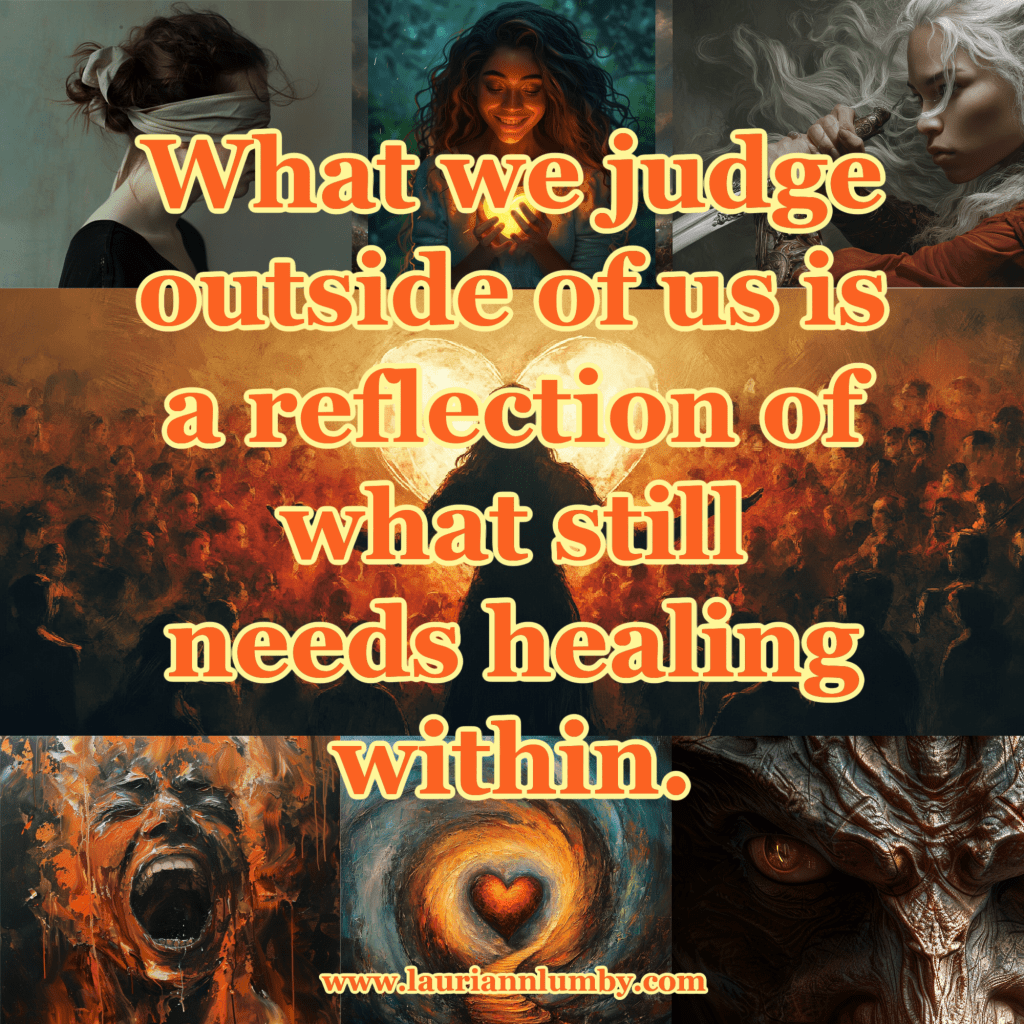
I want to start out by saying I do not believe in “demons” in the classical sense of a dude in a red unitard sporting horns and carrying a pitchfork. Instead, I perceive of demons more in the psychological sense of fears, both inside and outside of us, that influence our beliefs, our actions, and our behaviors. These are the fears that have arisen from within us in response to all the things we have seen and experienced that have made us forget our original nature as Love. These fears manifest as “demons” in both a microcosmic and macrocosmic sense – the former as our own personal non-loving beliefs and behaviors, the latter manifesting as organizations and institutions who get their (perceived) power through these fears.

It was the latter that I bore witness to this past weekend and from which, on this fourth day, I am only just recovering. For the sake of the innocent, I will simply say this – I attended an event that throughout the duration, I felt the overwhelming need to flee. Being there for the sake of people very dear to me, I made myself stay, all the while finding myself cringing inside from an energy I couldn’t quite identify. I witnessed and heard things that made me want to scream and other things that broke my heart. I witnessed very little (of what I would call) truth and a lot of what I would call lies. I chastised myself for “being so judgmental” while also experiencing deep confusion over what I thought I knew. It took all of my personal energy to sit still and remain silent (mostly) in the face of what – at the time – I couldn’t quite name. When the event came to its conclusion, I hugged those dear to me and left. I have spent the last four days recovering and trying to make sense of what I had experienced.

Here’s the instructional part of this writing:

There are so many ways I could have responded to this experience. I could have simply wrapped my own blanket of self-righteousness around me, making myself right and what I witnessed wrong. I could have made the decision to close my heart’s door to the hosts of the event, brushing them off as “evil” or “ignorant.” I could have chased down friends of like mind to help me make sense of the overwhelming confusion I felt. I could have gone home and just remained sick and depressed. Instead, I brought the entire experience into my prayer. This was the first reminder I received:

Confusion isn’t a failure on my part, or a result of me not understanding or agreeing to something. Confusion is a symptom of “the devil” (ie fear) at work. So I brought this confusion into my prayer. I sat with it. I felt it. I drew myself into it. I asked it to show me what was at the heart of this confusion.  As I sat with the confusion, I eventually saw the fear, along with what some had wrapped around themselves in an attempt to absolve themselves of this fear. FEAR imprisoned behind a mask of religious zeal, perceived certainty, righteousness, and exclusivity.

Once I identified the confusion, the fear behind it, and the bars behind which the fear was imprisoned, all the “ick” I had been feeling simply lifted from my being. I felt clear and my peace was restored, and with that my own temptation to judge was replaced with compassion. I immediately felt deeply sad for those who have become imprisoned by their fear and have forgotten the infinite Truth of Love. I then brought MYSELF into my prayer – so that I might be freed of my own temptation to judge, to divide, to proclaim a monopoly on truth, and to sit on my own throne of self-righteousness. At the end of the day, who am I to “judge” how others respond to fear. If containment gives someone peace, then who am I to project my own compulsion for unlimited freedom onto them?

Another note about “demons.” Sometimes what we call judgment isn’t judgment at all, but is our inner truth barometer (discernment) alerting us to things around us that are not in alignment with our own truth. Perhaps this was what I was feeling at this event more than anything else – a felt sense within me of misalignment. I’m not wrong. They’re not wrong. I was simply feeling that their truth was not my truth and I can honor that. I don’t need to defend my truth. Neither do I need to point out the “error” in theirs. I can be witness to the Love that is present even (especially) when it is being lived out differently than mine. Because – at the end of the day, we are all afraid and demons exist only in our minds. We decide what power we give to them, or if instead, we hold them in Love.
Navigating Loneliness

Loneliness is a natural consequence of spiritual awakening. As we grow spiritually, turning inward to come to know and more fully embrace our true selves, we find the world and the life we were living less satisfying. We find ourselves seeing the illusion and falsehoods of the traditional systems of the world and find these increasingly uncomfortable. We find that we no longer fit in with the jobs, people, and experiences to which we had been giving time and attention. As we grow spiritually, we find that we never really did fit into these roles, but that these were just masks we wore to be accepted and acceptable to the system.

The more we tend to our inner journey, the less interest we have in spending time or energy with anyone or on anything that isn’t supportive of our truth. We cut away the relationships that are harmful or draining while cultivating a more peaceful and gentle life. Eventually, we discover that our “friend” circle has become very small – made up mostly of other people who have done similar spiritual work on themselves – and our relationships with these people are less about a need for belonging or gaining acceptance, and more about mutual sharing, support, and respect.

The need to belong is one of the greatest hurdles to becoming whole. The need to belong arises out of a codependent need for acceptance, and the price of that belonging is often no less than our souls. We lose ourselves in our compulsive need to be loved and accepted when the only love we truly need is the love we have for ourselves. Many become stunted in their spiritual growth because they are afraid of losing that (false) sense of belonging and because they are afraid of being alone.

Being alone is in fact one of the greatest gifts we can give to ourselves. It is in solitude that we are quiet and still enough for our deepest wounds, unhealed traumas, unnamed and unmanaged fears have the room to surface. It is because of this predictable dynamic that many avoid the solitude that their soul desperately needs. Loneliness is one of the aspects of our conditioning that surfaces in that space of being alone.

Loneliness is at once natural, and a conditioned response based on fear. As a species, it has been demonstrated that we need community to survive. Being wholly alone is not healthy for anyone. We need human interaction. As a species, we are interdependent. We could not survive without the collaborative work of the pack – each individual sharing their own unique gifts for the sake of their own fulfillment, and in service to the all. Loneliness, in this case, is a gentle reminder that we need human connection.

Loneliness as a response to fear, however, is less about our natural inclination toward tribal interaction, and more about the shield that flies up in protection of the ego (false self) when we are getting closest to our deepest wounds. The ego could be said to have its own life based on conditioning and on the fears that keep us imprisoned in the system. The ego defends itself when it feels threatened. It does not want us to heal or grow because with every step toward healing, a piece of the ego dies. Loneliness is one of the shields the ego throws up in defense of itself.

When loneliness arises in our consciousness, our first inclination is to find a solution to loneliness – to make it go away. We desperately seek after anything that will fill that emptiness that accompanies loneliness. Some turn to food, drugs, or alcohol. Others turn to compulsive activity. Others seek for someone (anyone) to make them feel less alone. Sometimes, the someone arrives disguised as love, but most often proves itself to be just another face of dysfunction.

These efforts to fill the hole left behind by loneliness will always fail, as the result of these attempts are fleeting and impermanent at best. Eventually, we end up right back in a pit of loneliness, except this time, the pit has grown deeper.

The actual remedy to loneliness exists, not in resisting it or trying to make it go away, but in being with the loneliness to find out what it has to say to us. What is the fear that loneliness has hiding behind or beneath it? Is it the fear that we are not loved? Is it the fear that we are alone? Is it the fear that we are insignificant and have nothing to share in the world? Once we can identify the fear, then we can do the work of healing it, and in that healing, becoming free of that fear.

One of the greatest gifts I have given to myself, was a 30 day loneliness practice. I was somewhat newly divorced and thinking I needed to find a new person who would love me. It turned out the person I was really looking for to love me was myself. The loneliness practice supported me in arriving at that knowledge and in doing the healing work that allowed me to be mostly free of loneliness.

For the loneliness practice, I turned to Tonglen. Tonglen is a mindfulness practice from the Tibetan Buddhist practice that supports us in being with our pain, our loneliness, and our fears.  Being with these wounded aspects of ourselves allows us to be healed of them. Here are my instructions for Tonglen taken from my online course “Starting a Spiritual Practice:”

Tonglen—a Tibetan Buddhist Healing Practice

Tonglen is a simple breathing and visualization practice that helps us to release powerful,

negative feelings and emotions.  Instinctively, when we experience a negative feeling or  

emotion, we are compelled to push the feeling away.  Tonglen invites us to do the opposite – to bring the feeling in so that it can be healed, transformed and released.

1) First, we FEEL the feeling. We allow ourselves to welcome it instead of pushing it away.

2) As we feel the feeling, we identify where in our body we are feeling it. 

3) If possible, we name the feeling (is it shame, hatred, anger, resentment, sorry, guilt, betrayal, etc.)

4) After we have identified where in our body we are feeling and feeling and if possible,

identified what the feeling is, then we breathe into the feeling.  More specifically, we breathe into the place in our body where we are feeling the feeling….while allowing ourselves to feel it. 

5) After breathing into the feeling, we breathe out love. While breathing our love, we might

also visualize what love looks like—maybe it is light and it has a color, perhaps it is the shape of a heart or the wind.  

6) As we breathe out love, we imagine it going out into the world, maybe even to any person

or persons who may be somehow connected to the negative emotion we are feeling. 

7) We continue this process of feeling the feeling, breathing it into our bodies and breathing

out love until we either feel a shift, or simply run out of time.  If during the practice we find

ourselves brought to tears, this layer of pain or woundedness has been freed and released.

8) Tonglen can be turned to again and again and again for the release of negative emotional

states.  We can us it both symptomatically (as a negative feelings arises) or therapeutically

(for example, daily if working on deep seated negative emotions or old and lingering emo

tional wounds).  

To free ourselves from the imprisonment of loneliness and its resulting fear, apply Tonglen to loneliness. With this I recommend a two-pronged approach. The first is a foundational approach.  In this, set aside 10-20 minutes each day to be with loneliness, applying the practice of Tonglen. The second is the symptomatic approach. WHEN you find yourself feeling lonely, apply Tonglen to that loneliness. Tonglen can be done at any time, anywhere, no matter what activity you are engaged in. It is a powerful tool for freeing ourselves from the loneliness that might otherwise drive us to act in non-loving or unhealthy ways toward ourselves. Tonglen also allows us to be freedom of the ego’s shield of loneliness so that we might increasingly escape the system that keeps us imprisoned in the false self, thereby freeing us to live more and more as our truest self.


Lauri Ann Lumby, MATP, provides one-on-one mentoring and support for those who are in the process of their spiritual journey and who are awakening to their highest selves and their most authentic truth. Lauri helps you to shed the layers of the ego made up of conditioning, past wounds and trauma, and fear so that your Soul might be free to live as its truest self.