Preamble:Today (1.25.26) I am heartbroken. Yesterday, in the early morning hours following the largest peaceful protest in the history of Minneapolis (50,000+), seven ICE agents gunned down an innocent man, Alex Pretti who had been defending a woman being harassed by ICE. The ICE agents pepper-sprayed him, beat him to the ground, and then shot him several times. The incident was filmed by several civilians and the conclusion is obvious.
Alex Pretti was murdered.
Today’s news revealed that the initial shooter has been removed from ICE duty in Minneapolis and moved to another state where he may continue his duties. I’m heartbroken and horrified. More even than this, I’m disgusted with every single member of Congress and the Supreme Court who are doing NOTHING to hold the president accountable for the wave of violence he has unleashed upon this country. I am all for enforcing immigration laws, but this is NOT how it is done in a reasonable society. Sadly, the United States left “reasonable” behind a long time ago.
That being said, while our elected officials are sitting on their hands, I continually am inspired by the actions of Minnesota residents in their ongoing attempts to draw attention to, and put a halt to ICE’s occupation of the Twin Cities. While ICE is out targeting any person who gets their attention (please note that the two most recent executions were white, US citizens), Minnesotans are providing for and protecting their neighbors at risk, accepting donations to help assist those in need, and holding peaceful protests in sub-zero temperatures. Minnesotans are proactive, organized, and driven in their attempts to uphold and defend the constitutional rights of all humans – citizens or not.
I am so proud of my hometown.
In the midst of the serious business of revolution, Minnesotans have also found a way to express their creativity. Whether it be through singing, movement, poetry, writing, or art, the Twin Cities are finding ways to be activists using their own unique gifts. One such example is the “Rebel Loon” images that have been popping up all over social media and beyond:
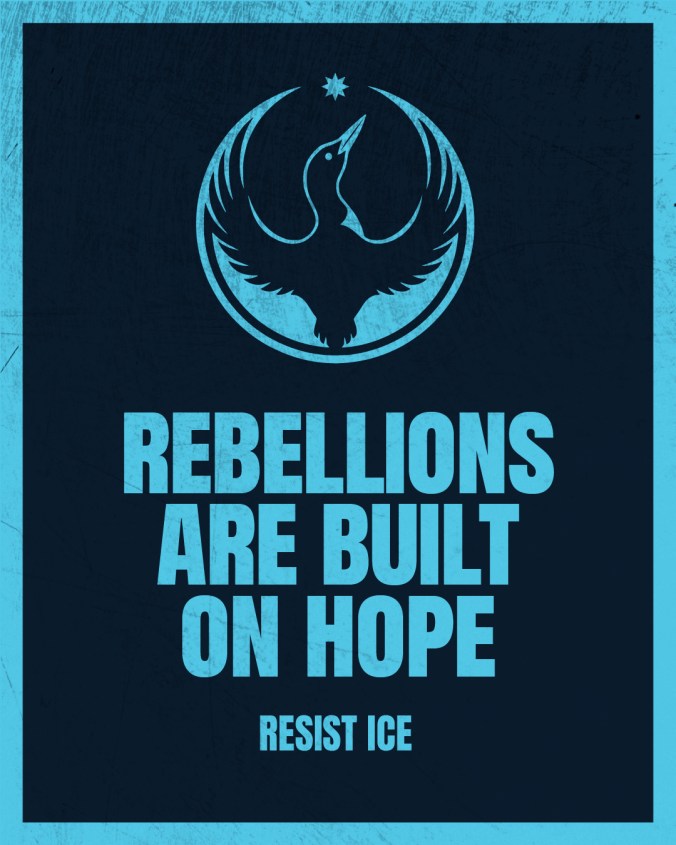
Inspired by the symbol for the Star Wars Rebel Alliance, graphic designers and artists have created myriad interpretations of the Rebel Loon logo to represent their unique community of activists. Out of their work, I was inspired to create something of my own. I have no idea of what this is for, or where it might be going (other than a momentary action to comfort my feelings of helplessness), but here it is along with some initial brainstorming to accompany my own tiny contribution to the revolution.
May the Force be with us!
 Lauri Ann Lumby