I want to start out by saying I do not believe in “demons” in the classical sense of a dude in a red unitard sporting horns and carrying a pitchfork. Instead, I perceive of demons more in the psychological sense of fears, both inside and outside of us, that influence our beliefs, our actions, and our behaviors. These are the fears that have arisen from within us in response to all the things we have seen and experienced that have made us forget our original nature as Love. These fears manifest as “demons” in both a microcosmic and macrocosmic sense – the former as our own personal non-loving beliefs and behaviors, the latter manifesting as organizations and institutions who get their (perceived) power through these fears.
It was the latter that I bore witness to this past weekend and from which, on this fourth day, I am only just recovering. For the sake of the innocent, I will simply say this – I attended an event that throughout the duration, I felt the overwhelming need to flee. Being there for the sake of people very dear to me, I made myself stay, all the while finding myself cringing inside from an energy I couldn’t quite identify. I witnessed and heard things that made me want to scream and other things that broke my heart. I witnessed very little (of what I would call) truth and a lot of what I would call lies. I chastised myself for “being so judgmental” while also experiencing deep confusion over what I thought I knew. It took all of my personal energy to sit still and remain silent (mostly) in the face of what – at the time – I couldn’t quite name. When the event came to its conclusion, I hugged those dear to me and left. I have spent the last four days recovering and trying to make sense of what I had experienced.
Here’s the instructional part of this writing:
There are so many ways I could have responded to this experience. I could have simply wrapped my own blanket of self-righteousness around me, making myself right and what I witnessed wrong. I could have made the decision to close my heart’s door to the hosts of the event, brushing them off as “evil” or “ignorant.” I could have chased down friends of like mind to help me make sense of the overwhelming confusion I felt. I could have gone home and just remained sick and depressed. Instead, I brought the entire experience into my prayer. This was the first reminder I received:
Confusion is the work of the devil.
Confusion isn’t a failure on my part, or a result of me not understanding or agreeing to something. Confusion is a symptom of “the devil” (ie fear) at work. So I brought this confusion into my prayer. I sat with it. I felt it. I drew myself into it. I asked it to show me what was at the heart of this confusion. As I sat with the confusion, I eventually saw the fear, along with what some had wrapped around themselves in an attempt to absolve themselves of this fear. FEAR imprisoned behind a mask of religious zeal, perceived certainty, righteousness, and exclusivity.
Once I identified the confusion, the fear behind it, and the bars behind which the fear was imprisoned, all the “ick” I had been feeling simply lifted from my being. I felt clear and my peace was restored, and with that my own temptation to judge was replaced with compassion. I immediately felt deeply sad for those who have become imprisoned by their fear and have forgotten the infinite Truth of Love. I then brought MYSELF into my prayer – so that I might be freed of my own temptation to judge, to divide, to proclaim a monopoly on truth, and to sit on my own throne of self-righteousness. At the end of the day, who am I to “judge” how others respond to fear. If containment gives someone peace, then who am I to project my own compulsion for unlimited freedom onto them?
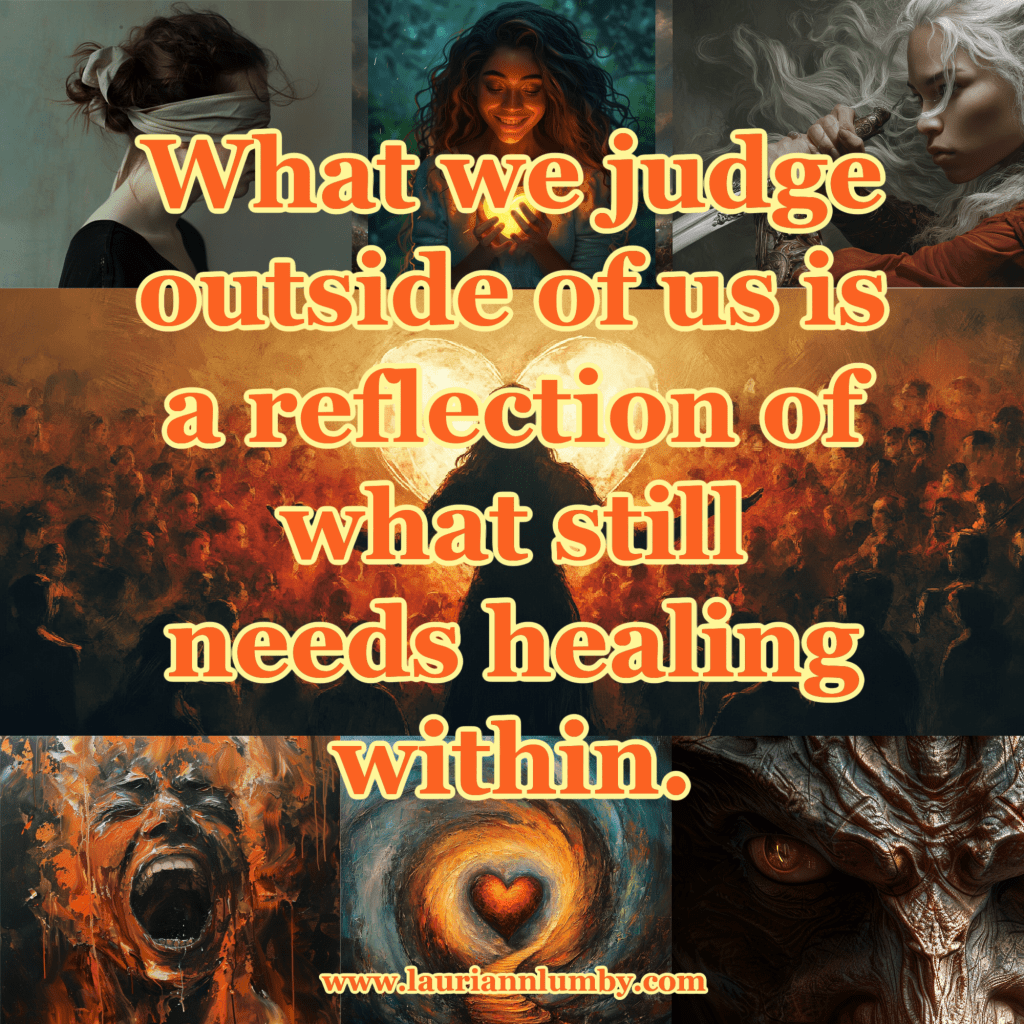
Because here’s the real deal with demons – what we judge outside of ourselves is a reflection of what still needs healing within ourselves, and sometimes we can’t see it in ourselves until it is standing right in front of us. Hello mirror!
Another note about “demons.” Sometimes what we call judgment isn’t judgment at all, but is our inner truth barometer (discernment) alerting us to things around us that are not in alignment with our own truth. Perhaps this was what I was feeling at this event more than anything else – a felt sense within me of misalignment. I’m not wrong. They’re not wrong. I was simply feeling that their truth was not my truth and I can honor that. I don’t need to defend my truth. Neither do I need to point out the “error” in theirs. I can be witness to the Love that is present even (especially) when it is being lived out differently than mine. Because – at the end of the day, we are all afraid and demons exist only in our minds. We decide what power we give to them, or if instead, we hold them in Love.
 Lauri Ann Lumby