Wandering, Wandering, Aimlessly Wandering

Aka – Life in the Void

This morning, I woke up with a million topic ideas wrestling in my head. Do I write about collective despair or survival? Do I muse on about living as an interdimensional being? Do I remark on the radically different lives many of us find ourselves living? Do I talk about the state of our world (yes, let’s go ahead and beat that dead horse!)?

When I sat in the center of these swirling topics, I realized that the common thread in all of this is where we find ourselves at this moment – Sitting in the void between a world that is coming to an end and a world that has not yet been fully born. Void space, as I have come to know it, is a restless place filled with anxiety and certainty, yet when we know how to move through our need to control, we find the deep, dark, peace that is at the center of the Void. (Psst: The Void could also be called “Source,” for it is out of the Void that all things come into being).

The world as we have known it is dying. I need only point to the community engagement I was invited into this week regarding a $6 million deficit facing the Oshkosh Area School District. The current proposal for balancing the budget includes the elimination of 23 full-time equivalent positions in “elective” classes, specifically art, music, theatre, industrial and culinary arts, and more. Of course I did my part in writing to the Board and the OASD Administration on why maintaining these classes is important and the impact these classes have on students, along with the devastating effect eliminating these classes would have on student enrollment and graduation rates. I did the proper 3d world thing on a topic I am passionate about.

At the same time…….I know that education is one of the systems that is facing its own death as the empires around us collapse. Education, as we have known it no longer works – if it ever really did. Education, like all other patriarchal/hierarchical institutions, is clinging hard to status quo. In my letter to Oshkosh schools’ leadership, I called for innovation while knowing that they have neither the courage nor the insight to accept that invitation. The superintendent offering no acknowledgement or response to my letter says it all. OASD will be dying along with all other educational institutions who would rather live in denial than do the hard work of radical reform.

Radical reform is what the new world is calling for. For those with eyes to see, we see this and we know this. We know and understand what will need to pass away, collapse, or die in order for the new to come forth. We know and sense the new, but for those of us of a certain age, it is not ours to build. No, our children, and our children’s children will be the ones creating the new world – as they already are.

And yet, here we are, in the space between a world that is in freefall and a world yet to be born. It’s a strange place. Everything feels bad, uncertain, worrisome, violent, and despairing. This is the place of the unknown and in the face of the unknown there is anxiety. The signs of death are everywhere – from increasing grocery and housing costs, to political insanity. Everything sucks. In the suck, we become restless, aimless, wandering. We are trying to find ground, balance, safety, and security. We desperately want to feel safe in a world that is everything but safe. We are desperate to have control over something uncontrollable.

The temptation is to get swept up into the chaos of a world trying to die, believing that this chaos is our reality. IT IS NOT!  The chaos is only a symptom of a dying world. Beyond the chaos, or rather, below and within it, is the true reality – that of THE VOID. The Void is the space between death and new life. It is the Source of all that is and the emptiness from which all things come to be. The Void is the “No Thing.”  It is the ultimate place of peace, comfort, and hope. When we allow ourselves to be objective witness to the chaos swirling around us, and not get caught up in it, our wandering settles, our restlessness becomes calm, we are able to release our need for control, and we are able to simply meet life as it is with acceptance and surrender. Remembering, in the immortal words of J.R.R. Tolkien, not all who wander are lost.


Everything is a Practice

Finding our way along the journey of self-actualization and personal mastery, we eventually come to the realization that everything is a practice. Whereas the early stages of our journey may have put us on the path to setting time aside each day for a dedicated mindfulness, contemplation, or meditation practice, we soon come to find out that our dedicated practice begins to spill out into the everyday experiences of our lives. Soon, everything becomes grist for the mill as we work to heal all within us that separates us from our original nature as love, while continuing to love the pieces that are not yet healed.

For me, this “everything practice” showed up in one extremely subtle and another powerfully obvious way.

I’ll begin with the extremely subtle:  I’ve been noticing in my daily practice an almost undetectable sorrow. It showed itself as a sorrow I could not initially name, but felt very deep and infinitely small. When I reached toward this sorrow, I perceived it as a tiny dot, no bigger than the end of a pencil. As it my practice, I’ve spent this week “working” on that dot of sorrow. Going toward it (instead of away). Pointing to it and “sending” healing. Holding the sorrow and asking what it had to say to me or teach me. The goal of this practice is to simply show up to that sorrow. In my experience, the fruits of this kind of practice eventually lead to healing and release, or alternatively, the revelation of something hiding behind the sorrow that seeks to be known. I’m still working on this piece, but I have gotten a glimpse of the original wound of separation that is just beyond this sorrow. That glimpse nearly gave me a panic attack, but I know that the only way to continue healing that wound is to stay with it.

The powerfully obvious way that everything presented itself as practice arose in a fit of rage. Without boring you with the gory details, suffice it to say that the rage was in the form of ranting resentment over a need for which I had requested support. The support was denied. To be honest, as I write this, I’m still pissed. First – because I rarely ask for help. Second because I should have known better.

What I do know, however, is that beyond the ranting and raving (which are appropriate inner responses to our needs not being met) is an old wound showing itself for another layer of healing – the wound of unmet needs. This is a pretty universal wound in that most people can share stories, experiences, conditioning, etc. in which their needs have gone unmet, or been flat-out rejected. Every time we have the courage to ask for help, and it is denied, a part of us feels like it has died. Heap up a lifetime of rejected and unmet needs, and the wound becomes a gaping hole. For myself personally, this is a wound I’ve given much time and attention to in the form of transformational practices. And, just like most everyone else, it’s a wound that still needs love. First, we have to work on healing the wound of rejection. Next, we tackle the wound of unmet needs. Finally, we do the work of meeting our own needs while setting appropriate boundaries around those who, due due to their own unhealed wounds (likely), are unable to be a reciprocal source of support for others.

From the very subtle to the greatest of charged emotions, everything is our self asking to be seen, known, and loved. This love, ultimately, is what our practice is all about.

The Things We Cling To

The journey toward self-actualization, enlightenment, individuation, and personal mastery (all words meaning essentially the same thing) is rough. In our western, capitalistic culture in which personal development has been commoditized, we’ve been told to expect unicorns and rainbows, when instead, we are faced with hellfire and brimstone. Personal mastery is not for the faint of heart. Neither is it for the weak. Instead, it requires persistence, discipline, and the willingness to confront and lay down every attachment and mask that hides us from our true selves.

Our true self is LOVE. Period.

Another way of describing the journey is the transformation of every single thing within us that has forgotten we are love. In doing so, we are simultaneously remembering how to love ourselves for all that we are – warts and all.

Self-actualization is not about perfection. Instead, it is about becoming increasingly aware of our human frailty and loving even that.

In coming to recognize, acknowledge, accept and love our imperfect perfection, we are invited to identify and release all the things we cling to that stand in the way of radical self-love. Much of what we cling to has been beaten into us by our culture. Some have surfaced out of past woundings. Many emerge out of trauma. Others we cling to simply because we are human. Here is my list of the things we cling to that are often the most difficult to release:

  • The desire to belong.
  • The need for approval from others.
  • The longing to be seen.
  • The yearning to be heard.
  • The need to be right.
  • The desire to know.
  • The need to be in control.
  • The yearning to be desired.
  • The habits, patterns, behaviors, status to which we have become familiar.
  • The illusion of success.
  • Conditioned beliefs about value and achievement.
  • Our health.
  • Life.

The truth of the human experience is that everything is temporary and nothing can be controlled. We are not here to make other people happy. Neither are we here to gain other people’s approval. Belonging is an illusion, and it is only the false self that needs to be seen, heard, or loved. Our value is not dependent on any one else’s definition or rules of measurement.

We have value, and are loved, simply because we are. When we remember the Love that we are, and release these attachments, only then are we free enough to love ourselves for all that we are, and to see that love in others – no matter how broken we or the other might appear.

Releasing the things we cling to most stubbornly brings us into the field of personal mastery. There might not be unicorns or rainbows here, but there is true and enduring freedom.


Tools for Releasing Attachments

Spiritual Appropriation and White Privilege

Today I write with a question for our community. It is a question about which I welcome and invite your response. The question is about spiritual appropriation and white (colonizer) privilege. When seeking definitions related to this topic, I found Google to be the most succinct:

Cultural appropriation is the adoption of elements from a minority culture by a dominant culture in a way that is disrespectful, exploitative, or that strips the cultural element of its original meaning. A key factor in identifying appropriation is the power imbalance between the dominant and minority cultures, where the dominant group benefits from something that the marginalized group may be mocked or punished for. 

Key Characteristics

  • Power Imbalance: 

The act often occurs when a dominant culture borrows from a marginalized or minority culture, leveraging its power to gain benefits from the culture it is borrowing from. 

  • Disrespect and Exploitation: 

Elements are taken without understanding their significance, which can strip them of their original meaning or turn them into a stereotype. 

  • Lack of Credit or Compensation: 

The dominant group may profit from or receive credit for cultural elements, without acknowledging their source or providing compensation to the marginalized group. 

  • Reinforcing Oppression: 

The act can reinforce harmful stereotypes or contribute to the oppression of the marginalized group. 

I have seen examples of this throughout my spiritual journey – from people of white, European descent taking on rituals and practices of indigenous people or adopting devotional practices that originated in West Africa and arrived here through slave-trade. I have admittedly been somewhat guilty of this myself as my spiritual journey guided me toward teachers and scriptures, rituals and practice that are not of my own Catholic, Western European ancestry.

Appropriation becomes a difficult question, especially for descendants of colonizers who in the melting pot of the United States, Australia, New Zealand, and Canada, find ourselves in cultures without a culture. In the journey of trying to find ourselves, we are also looking for what defines us and speaks to us as a culture. In this exploration, it is natural to seek outside the (mostly Christian) traditions that were handed down to us through our ancestry.

But in exploring these non-white, non-Christian traditions, beliefs, and practice, when does it become appropriation?

In responding to this question, I can only speak for myself, and the answer comes several-fold:

  1. The first part of my response is in the fact that in every “other” tradition/practice I have explored, I was always brought back to what I already know and which I can authentically claim as part of my own ancestry. In exploring, I have found truths and teachings that mirror and deepen what I have learned through my own Catholic/Christian contemplative practices. Through Eastern wisdom literature, for example, my adherence to Jesus’ teachings on oneness, love, etc. has only become more sure.
  2. Fact: the Catholic Church is one of the first and worst colonizers of indigenous people.  Catholic rituals have their roots in Judaism, Hellenism, the Roman culture, and the existing pre-Christian communities of the Mediterranean basin, and Western Europe. In its march west and north, the Catholic Church gobbled up (appropriated) the traditions and practices of the people they sought to subjugate. As my Celtic/Irish ancestors were one of those most targeted, I feel entitled to reclaiming these rituals and practices for myself without apology. If the frame drum (bodhran) and Irish female Shamanism is a part of my ancestry, then I feel it is not only my right, but my duty, to reclaim it.
  3. If, in the context of my professional work, I find myself sharing a practice or ritual from a culture outside my own (which is rare), I give credit along with the name of those from whom I learned the practice and/or was given permission to share.
  4. I really, really, really try to stay in my own lane. Hence, the use of primarily Judeo-Christian contemplative practices, Judeo-Christian scripture (canonical and otherwise), and Judeo-Christian or Irish ritual practices. If it’s not from my ancestors, or the tradition in which I was raised, I don’t feel I have a right to it.
  5. Now, there are two roads for me where walking the fine line of spiritual appropriation as a person of white European ancestry gets a little tricky.  Yoga and Pre-Christian/Jewish mysticism (ie: the Kabbalah).  I practice yoga. I have studied Vedic teachings and thought. I have been trained in chakra theory. I participate in Vedic chant and kirtan. From original source material, I have been a devoted student of Kabbalah and have utilized both the Practical and Mystical Kabbalah for my own spiritual development. I, unfortunately, have not had access to the guidance of a Rabbinical teacher of Kabbalah. Neither have I studied under the guidance of an Indian Vedic guru. These latter two points are probably a good thing as I could never become so arrogant in either field as to claim expertise. As I openly say to my students and friends who have explored these topics with me, “I don’t even know enough to get myself in trouble

Again, I bring this topic forward for community discussion and exploration. For me, I think the line between spiritual appreciation and spiritual appropriation lays in questions of ancestry and use. For me, ancestry is clear. Use is maybe a little less clear. Am I financially benefiting from something I learned from another culture? Maybe. Sometimes. Am I giving proper credit to the origin of what I share?  Hopefully always!  Am I causing harm to the originating culture in the sharing and use of these practices?  I sure hope not.

As a person of white, European, colonizer ancestry, I feel it is critically important that we ask ourselves these questions. I will also admit the answers are sometimes unclear and we might make mistakes along the way.

I welcome your thoughts and reflections on this topic! 

Thank you!

With love,

Lauri

When September Ends

I’m hoping that what comes through me here today provides some sort of comfort, or at the very least, validation and affirmation for the small community that finds its way here.

September sucked.

I can’t even begin to point at the whys or the hows of it, but September was a truly challenging month, for me, and for many others I know. I would be easy to point our fingers at the obvious – certain political and global events that cast the world into a frenzy. But that’s only on the macro. Closer to home, it seems that every person I know was faced with some sort of bizarre fuckery during the strange month of September.

For me, the strangeness included bizarre human behaviors, out of left-field conflicts, unhealthy people trying to project their unhealed shit on me, and over $600.00 in unexpected expenses.

All of the above is pretty much par for the course, but when I’m draining what little I have of a savings account to cover September’s extra expenses, I find myself in a place of real doubt and fear, and all of my most vulnerable questions resurface.

“Not having enough ($)” really is my core fear and the one that has been the most stubborn lesson for me in this life.

So this morning, as I dared to look at my checking account balance, and felt the visceral fears arise, I did the only thing I know to do:

I prayed.

Then I was led to a few resources that provided comfort and reassurance. In these I was reminded that THIS MOMENT is a temporary thing. THIS MOMENT is not the herald of doom.  Neither is it the object of my fate.

I was also reminded of the strange miracles that happened in the midst of September’s perceived struggles – miracles that arose out of what initially felt like doom. Certain ghosts of my past paid me a visit and, in these visits, old wounds and deep pain resurfaced. But once I was able to identify the theme, the miracle appeared, and a profound reconciliation took place.

This is what happens with struggle when we allow ourselves to BE WITH IT instead of trying to run away. I didn’t run when the ghosts re-emerged. I allowed myself to be with the depth of emotion and the heights of the pain. I sat with it. I raged. I wept. I raged some more.

Same with the money. I see the fear. I am aware of it. I’m fully conscious of the doubts that surface when I’m in the glut – mostly I question my place in this world and what I’m doing “wrong” with this one life I have. But like ghosts, I sit with the fear. I feel it. I pray. I ask for guidance.

This morning the guidance came. Recently, I have included a daily reading of poetry into my practice. This morning, these words from Mary Oliver pierced my anxious mind:

“Going to Walden is not so easy a thing

As a green visit. It is a slow and difficult

Trick of living, and finding it where you are.”

THIS!  We’re all looking for “Walden,” aren’t we? No matter how we define that, we are looking for that place of peace. Thoreau sought it and found it in his time at Walden Pond, but it was not the pond itself that was the source of peace. Thoreau discovered the true source of peace was within him – but he had to get quiet enough to find it. Walden gave him that quiet.

Whereas we are tempted to believe that escaping the hustle and bustle of our everyday life and struggles is what we need to find this peace, Oliver points out that everywhere is Walden. Rather, WE are Walden. What we are seeking is right here, right now, exactly where we are, and whatever is transpiring around us. We just need to be still enough, and willing to FEEL the full extent of our unease, to find it. Peace is where we are – no matter where, what, or how that is.

September comes. September ends. And still our fears remain. We do not, however, need to be the victim of those fears. Allowing ourselves to be with whatever struggles life hands us, while identifying and being with the resulting fears, is ultimately the pathway to peace.

THIS MOMENT is not our fate. Instead, it is the source of our salvation – when we have the courage to be with it….because as is always the case, “this too shall pass.”

What struggles did September bring to you?  How did you find your way through them?


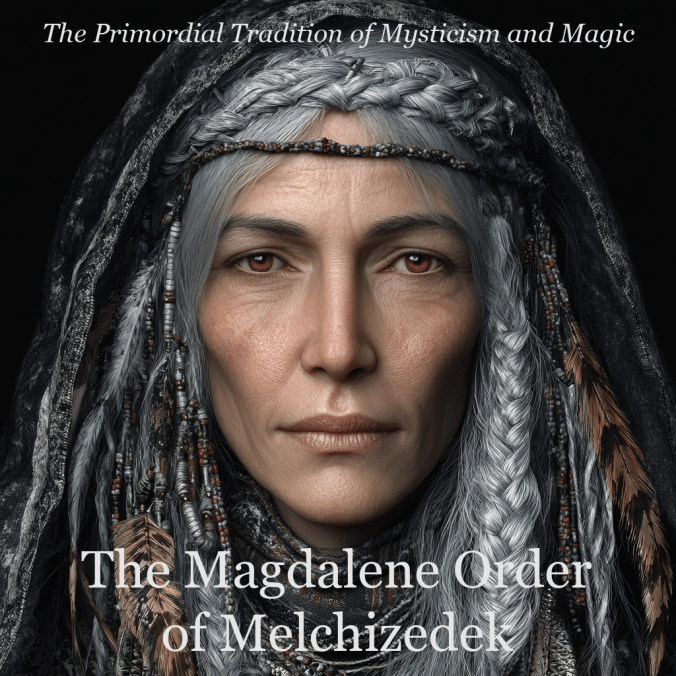
The Magdalene Order of Melchizedek is a 2-year training program providing participants instruction, guidance and support in the deep work of inner liberation.

Not Your Celebrity’s Kabbalah

Welcome to the official launch of my newly revisioned Order of Melchizedek Training!  This is a training that has been around for awhile, but which needed to be reconfigured – certain courses removed, and others added. Additionally, as times have changed, so too have the images related to this intensive training program. Without further ado, let me introduce you to the newly envisioned Magdalene Order of Melchizedek – the primordial tradition of mysticism and magic.

In short, the Magdalene Order of Melchizedek training is a comprehensive and intensive dive into the most ancient systems of personal growth and transformation which later influenced and inspired Hebrew, Gnostic, Coptic, Orthodox, and Christian schools of mysticism. Whereas these ancient systems bear no identifiable origin or name, they have been most clearly articulated through the Jewish Kabbalah.

The Magdalene Order of Melchizedek, however, is not your celebrity’s Kabbalah. This training bears no resemblance to the “red string” Kabbalah that has been lauded by pop stars and the Hollywood elite. We do not promise wealth, outside power, or fame.  

Neither is this training an attempt to appropriate the closely guarded Jewish mystical schools. As I am neither Jewish, nor have I studied with modern Jewish masters, it would not be appropriate for me to claim knowledge of their methods.

Instead, drawing from (as close to as possible) original source material and incorporating my lifetime(s) of cross-cultural mystical and theological studies, this training gets to the heart of the mystical intention which is, and has always been – UNION. Union with Source (that which some might call God), Union with our truest Self (what some might call our “God-self”), and Union with all of Creation.

LOVE is the ultimate goal of this training. LOVE, not of intellect or emotion, but LOVE that is embodied. Embodied Love is arrived at through a thorough and deep process of identifying, healing, and transforming all that is within us that has forgotten we are Love.

To support and facilitate Embodied Love, the Magdalene Order of Melchizedek guides you through ancient symbols, tools, and practices that illuminate the woundedness within us that seeks to be healed, while providing the foundation for healing those wounds. You are additionally supported through one-on-one mentoring.

The Magdalene Order of Melchizedek is not for the faint of heart. Neither is this a shiny object to be claimed. Instead, it is a deeply personal, intimate, and often challenging process for catalyzing change with an eye toward empowerment that endures. As creator and facilitator of this training, I will hold your feet to the fire, while providing comfort and encouragement through that fire. The Magdalene Order of Melchizedek is not a process to do alone, but only in the company of one who has walked that fire before you.

Navigating Loneliness

Loneliness is a natural consequence of spiritual awakening. As we grow spiritually, turning inward to come to know and more fully embrace our true selves, we find the world and the life we were living less satisfying. We find ourselves seeing the illusion and falsehoods of the traditional systems of the world and find these increasingly uncomfortable. We find that we no longer fit in with the jobs, people, and experiences to which we had been giving time and attention. As we grow spiritually, we find that we never really did fit into these roles, but that these were just masks we wore to be accepted and acceptable to the system.

The more we tend to our inner journey, the less interest we have in spending time or energy with anyone or on anything that isn’t supportive of our truth. We cut away the relationships that are harmful or draining while cultivating a more peaceful and gentle life. Eventually, we discover that our “friend” circle has become very small – made up mostly of other people who have done similar spiritual work on themselves – and our relationships with these people are less about a need for belonging or gaining acceptance, and more about mutual sharing, support, and respect.

The need to belong is one of the greatest hurdles to becoming whole. The need to belong arises out of a codependent need for acceptance, and the price of that belonging is often no less than our souls. We lose ourselves in our compulsive need to be loved and accepted when the only love we truly need is the love we have for ourselves. Many become stunted in their spiritual growth because they are afraid of losing that (false) sense of belonging and because they are afraid of being alone.

Being alone is in fact one of the greatest gifts we can give to ourselves. It is in solitude that we are quiet and still enough for our deepest wounds, unhealed traumas, unnamed and unmanaged fears have the room to surface. It is because of this predictable dynamic that many avoid the solitude that their soul desperately needs. Loneliness is one of the aspects of our conditioning that surfaces in that space of being alone.

Loneliness is at once natural, and a conditioned response based on fear. As a species, it has been demonstrated that we need community to survive. Being wholly alone is not healthy for anyone. We need human interaction. As a species, we are interdependent. We could not survive without the collaborative work of the pack – each individual sharing their own unique gifts for the sake of their own fulfillment, and in service to the all. Loneliness, in this case, is a gentle reminder that we need human connection.

Loneliness as a response to fear, however, is less about our natural inclination toward tribal interaction, and more about the shield that flies up in protection of the ego (false self) when we are getting closest to our deepest wounds. The ego could be said to have its own life based on conditioning and on the fears that keep us imprisoned in the system. The ego defends itself when it feels threatened. It does not want us to heal or grow because with every step toward healing, a piece of the ego dies. Loneliness is one of the shields the ego throws up in defense of itself.

When loneliness arises in our consciousness, our first inclination is to find a solution to loneliness – to make it go away. We desperately seek after anything that will fill that emptiness that accompanies loneliness. Some turn to food, drugs, or alcohol. Others turn to compulsive activity. Others seek for someone (anyone) to make them feel less alone. Sometimes, the someone arrives disguised as love, but most often proves itself to be just another face of dysfunction.

These efforts to fill the hole left behind by loneliness will always fail, as the result of these attempts are fleeting and impermanent at best. Eventually, we end up right back in a pit of loneliness, except this time, the pit has grown deeper.

The actual remedy to loneliness exists, not in resisting it or trying to make it go away, but in being with the loneliness to find out what it has to say to us. What is the fear that loneliness has hiding behind or beneath it? Is it the fear that we are not loved? Is it the fear that we are alone? Is it the fear that we are insignificant and have nothing to share in the world? Once we can identify the fear, then we can do the work of healing it, and in that healing, becoming free of that fear.

One of the greatest gifts I have given to myself, was a 30 day loneliness practice. I was somewhat newly divorced and thinking I needed to find a new person who would love me. It turned out the person I was really looking for to love me was myself. The loneliness practice supported me in arriving at that knowledge and in doing the healing work that allowed me to be mostly free of loneliness.

For the loneliness practice, I turned to Tonglen. Tonglen is a mindfulness practice from the Tibetan Buddhist practice that supports us in being with our pain, our loneliness, and our fears.  Being with these wounded aspects of ourselves allows us to be healed of them. Here are my instructions for Tonglen taken from my online course “Starting a Spiritual Practice:”

Tonglen—a Tibetan Buddhist Healing Practice

Tonglen is a simple breathing and visualization practice that helps us to release powerful,

negative feelings and emotions.  Instinctively, when we experience a negative feeling or  

emotion, we are compelled to push the feeling away.  Tonglen invites us to do the opposite – to bring the feeling in so that it can be healed, transformed and released.

1) First, we FEEL the feeling. We allow ourselves to welcome it instead of pushing it away.

2) As we feel the feeling, we identify where in our body we are feeling it. 

3) If possible, we name the feeling (is it shame, hatred, anger, resentment, sorry, guilt, betrayal, etc.)

4) After we have identified where in our body we are feeling and feeling and if possible,

identified what the feeling is, then we breathe into the feeling.  More specifically, we breathe into the place in our body where we are feeling the feeling….while allowing ourselves to feel it. 

5) After breathing into the feeling, we breathe out love. While breathing our love, we might

also visualize what love looks like—maybe it is light and it has a color, perhaps it is the shape of a heart or the wind.  

6) As we breathe out love, we imagine it going out into the world, maybe even to any person

or persons who may be somehow connected to the negative emotion we are feeling. 

7) We continue this process of feeling the feeling, breathing it into our bodies and breathing

out love until we either feel a shift, or simply run out of time.  If during the practice we find

ourselves brought to tears, this layer of pain or woundedness has been freed and released.

8) Tonglen can be turned to again and again and again for the release of negative emotional

states.  We can us it both symptomatically (as a negative feelings arises) or therapeutically

(for example, daily if working on deep seated negative emotions or old and lingering emo

tional wounds).  

To free ourselves from the imprisonment of loneliness and its resulting fear, apply Tonglen to loneliness. With this I recommend a two-pronged approach. The first is a foundational approach.  In this, set aside 10-20 minutes each day to be with loneliness, applying the practice of Tonglen. The second is the symptomatic approach. WHEN you find yourself feeling lonely, apply Tonglen to that loneliness. Tonglen can be done at any time, anywhere, no matter what activity you are engaged in. It is a powerful tool for freeing ourselves from the loneliness that might otherwise drive us to act in non-loving or unhealthy ways toward ourselves. Tonglen also allows us to be freedom of the ego’s shield of loneliness so that we might increasingly escape the system that keeps us imprisoned in the false self, thereby freeing us to live more and more as our truest self.


Lauri Ann Lumby, MATP, provides one-on-one mentoring and support for those who are in the process of their spiritual journey and who are awakening to their highest selves and their most authentic truth. Lauri helps you to shed the layers of the ego made up of conditioning, past wounds and trauma, and fear so that your Soul might be free to live as its truest self.

Seeking Refuge in Hell

Letters from Hell #5

Increasingly, people I know and with whom I am close are retreating from the everyday world. Me included. This retreat is partly an act of self-preservation, but even more so, it is a result of their awakening.

The self-preservation piece is obvious. People no longer want to be part of a world that is built on fear, power, and control. They no longer want to participate in the violent division that currently defines our world. They no longer want to fight or even be witness to the ignorance and hatred that fuels the fires of the hell humanity has created for itself. Instead, they are choosing peace and a sense of safety over ongoing conflict. They are choosing to separate from the noise so they may enjoy quiet. They are retreating into a sanctuary of their own making, based on what they have come to learn about themselves and their truest needs, wants, and desires.

This brings me to the awakening part. A dear spiritual brother recently shared with me a lecture given on the “disappearing” that was once predicted by Carl Jung. In short, Jung theorized that as human beings become individuated (Abraham Maslow called this self-actualization), they would come to realize that the system in which they were conditioned to participate no longer works for them. They see the system for what it is – false, abusive, and harmful and begin to find ways to detach themselves from the system. As they do so, they discover what their soul really wants and needs to feel whole, and they begin to choose that. For many, this choice leads them away from the outside world and into a space that is more quiet, peaceful, content, and gentle. This quiet place becomes their refuge from a world in which they no longer belong (if they ever really did).

This choice for refuge is available to all of us, when we so-choose it. Whether actively individuating, or simply wanting to find peace in a world at war with itself, finding refuge is simple:

  1. STOP engaging with the divisive tactics of the hell in which we are living. Don’t participate in the arguments, the projections, or the blame.
  2. Embrace the position of objective witness. Observe the dying world without reaction. See it. Observe it. Make note of it. But don’t get sucked into it.
  3. WHEN the dying world triggers your fears and unhealed wounds, instead of reacting out of those fears, STOP and engage in the many spiritual tools you have for easing and transmuting those fears.
  4. Start, or double-down on your daily spiritual practice. Make this your number one priority.  
  5. Be mindful of how and with whom you want to spend your time. Say NO to those people and activities that drain you or compel you to engage in division.
  6. Make your home a sanctuary. Gather around you the things that give you comfort and make you feel safe.
  7. Cultivate a routine of self-care. Choose at least ONE activity per day that feeds your soul – read, write, take a walk in nature, visit an art gallery, have coffee with a dear friend, watch a movie or documentary that informs or inspires. Cook a wholesome and delicious meal.
  8. Nap. The violence and discord of the dying world makes us tired. Get extra sleep and nap when you need to.
  9. Tell the “should” voice in your head to SHUT T.F. UP. “Should” is one of the strongest weapons of conditioning and is one of the ways we remain tied to the system. Cut the cord. Let it go. DO what you love and let the non-loving conditioning go.

Whether we acknowledge that the world we are living in is a kind of hell, or are simply outgrowing the conditioning that has kept us imprisoned by the system, refuge is necessary in our journey of finding peace and contentment in our lives. That refuge is available to you right now, if you so-choose.


Letters from Hell #2 – Rest

This morning, my thoughts have turned to rest. Specifically, rest, that it seems I am needing a great deal more of. I never needed rest before – or at least I acted like I didn’t need it. I would work from before dawn to after dusk Monday through Sunday. Weekends were taken up with chores – cooking, cleaning, yardwork, being a mom, etc. etc. etc. There was no time for rest – rather, I rarely took the time.

Living in hell is exhausting. Between “hearing (and feeling) the cries of the world,” the increasing division and violence, and the constant bombardment of traumatic events and chaotic actions, I have very little left to give – to anything – other than survival.

It’s no wonder when the weekend comes all I really feel like doing is sitting at home, reading, napping, and watching TV. I have zero bandwidth (or money) for much else. I don’t want to go anywhere or be by anyone. And please don’t ask me to go somewhere where there will be crowds. I get enough of the energy of people during the week, and I really cannot tolerate any more.

I suspect I’m not alone in this – at least among those who are paying attention. As a healer and an empath, I feel it all  – every person’s emotions, feelings, anxieties, frustration, anger, and fear. I can’t help it. My body is like some kind of processor for all the darkness that is erupting in our world. It comes into me and moves through me. It seems I have no choice in the matter. It’s part of what I’m here to do and be. And trust me, it is not out of pride that I share this – because I would not wish this “job” on anyone.

First, my home is my sanctuary. I have created it into a place of refuge and safety. It is my hermitage, my monastery, my cloister. With three-foot-thick concrete walls, it is a fortress in which I feel safe. I am here mostly alone or in the company of loved ones or special clients. To the world, my home is invisible. To be found, you must have been given an invitation.

Second, when I’m not at the job that provides the income I need for basic survival, I’m at home. Except for visits to the yoga studio, running basic errands, visiting my favorite coffee shop, I’m home. At home, I am deeply immersed in my practice – meditation, prayer, reflecting, writing, reading, and praying some more. Increasingly, in prayer is how I spend my time. I need it. The world needs it.

Third, I’ve learned to embrace rest. When I’m tired, I nap. When it’s not a “work day,” I rest. In this also, I find I no longer have a choice. I need it after all the energy it takes to live in this hellscape, to be forced to be out in the world, and to be one of the many witnessing and supporting humanity as it decides its own fate – an eternity in hell, the end of the human race, or if they will finally agree to embrace the opportunity they’ve always been given – which is to be Love.

Rising Above the Chaos

As the world as we know it continues in its collapse, there are bound to be times of unbridled chaos:

  • Chaos created by those who stand to lose power.
  • Chaos manifesting as distractions, impulsive actions, and irrational and rash decisions.
  • Chaos instigated as an attempt to control a narrative.
  • Chaos created in the hopes of causing confusion.
  • Chaos as the reaction to above-mentioned chaos by those unable or unwilling to acknowledge their own anxiety and sense of unease in the face of said-chaos.
  • Chaos in the irrational anger, frustration, and impatience that arises in the face of unacknowledged and unmanaged fear.

Human-created chaos and human-reactions to chaos, most simply, are symptoms of the death throes of a world imploding. When the life we have known approaches its end, humans’ initial tendency is to cling to what has been, and that clinging most often manifests in rash attempts to manipulate and control their own dying.

Death, however, cannot be controlled. When a way of being has lived out its usefulness, it comes to a natural end. Nothing can stop it. Neither should one try.

In the face of a dying, however, humans are rarely rational. This is especially true in those who do not know how to acknowledge or manage the natural fears that arise in the face of endings. This unacknowledged and unmanaged anxiety comes out sideways in angry, rash, impulsive, and often irrational actions. These actions can be enormously obvious such as deploying military troops “to help eliminate crime” in areas where crime has already been effectively managed, or as subtle as rudeness or road rage.

No one is immune to the natural fear of endings. We have two choices in the face of these fears: allowing the collective chaos to sweep us away in a storm of our own anxiety and worry, thereby triggering our own responses to fear; or acknowledging the anxiety that we are feeling and employing the tools and resources we have for mitigating and managing fear.

Tools for managing the fears we naturally experience in the face of a dying world (as we know it) include: medication, meditation, movement, music, mindfulness and mindful actions and activities. Mindful activities can include anything from cooking to gardening, hiking, exercise, making love, and more. Really, anything that allows us to rise above, or move beneath the chaos of a world in its death throes works. It doesn’t matter what form our practice takes. What matters is it allows us to be present with our anxiety and move through it so we are no longer a prisoner of our own anxiety, or vulnerable to the fear-driven actions of others; but instead, we are peaceful, content, and safe as the world around us goes up in flames.

How are you rising above or moving below the chaos to find your own place of comfort and safety?